Gun suicides must be taken seriously

National Suicide prevention weekFor far too long, we have ignored one of our country’s most serious public health problems- gun suicides. This week is Suicide Prevention Awareness week. Are we paying attention? The Brady Center has a new report out about the reality of suicide by gun which takes more lives than gun homicides. Let’s take a look at some of the points made in the report:

A gun in the home makes a suicide three times more likely according, to a 28-page report released today by the Brady Center to Prevent Gun Violence. The Truth About Suicide and Guns finds that while gun ownership alone presents the greatest risk, when combined with the impulsive nature of suicide and the effectiveness of a gun, the combination is deadly. In fact, 71% of people who attempt suicide do so within an hour after making the decision. Further, death results 91% of the time when a gun is used because injuries are instantaneous and leave little time for medical intervention or for the victim to reconsider their decision.

“A gun in the home makes it too easy for someone to find a permanent and tragic solution to a temporary feeling. This report is not about the right to bear arms; it’s about arming people with facts,” said Brady Center President Dan Gross. “The facts are clear — there is one, surefire way to drastically reduce the number of Americans who die from suicide each year and, simultaneously, make American homes safer: Keep guns out of the home or store them safely.”

Suicide by gun has increased since 2007 which is affirmed by many reports. When I spoke to my own Police Chief, he confirmed that he had been seeing more local gun suicides. The report from Brady has some numbers:

A closer examination of the causes of these deaths reveals some important trends. Over the past decade, the rate of firearm homicide has continued a steady decline. At the same time, the firearm suicide rate has begun rising, increasing more than 13 percent between 2007 and 2013. The combination of these two trends is keeping the overall gun death rate essentially stagnant.

Access to firearms clearly increases the risk of suicide as the report highlights:

Intervention during this time of acute risk is key to saving lives. Most people who attempt suicide don’t really want to die, they are just so overwhelmed by their emotions they feel unable to cope. Indeed, the vast majority of people who make it through a suicidal crisis do not go on to die by suicide. A systematic review of 70 studies following patients after a non-fatal attempt found that, on average, only 7 percent (range: 5 to 11 percent) eventually died by suicide, whereas 70 percent did not attempt again.

A common misconception is that people who want to die will find a way to kill themselves, with or without a gun. However, studies suggest that the risk of method substitution is low. If a person’s preferred suicide method is unavailable, it is unlikely they will switch to a different one. Even if another method is used it is likely to be less lethal, thus increasing the odds of survival. (…)

Research has shown that reducing firearm availability can lead to reductions in firearm suicide rates. In one study, researchers measured the impact of changes in household firearm ownership on suicide rates in the United States between 1981 and 2002. They found that each 10 percent reduction in firearm prevalence was associated with significant declines in rates of firearm suicide (4.2 percent) and overall suicide (2.5 percent). The effect was even greater among children ages 0 to 19. A more recent study of suicide on college and university campuses between 2004 and 2009 revealed substantially lower suicide rates for students compared to all 20- to 24-yearolds. These differences were attributed to the ninefold decrease in firearm availability on campuses versus homes.

The availability of guns clearly makes a difference. Guns are more lethal than other methods of suicide and, as the report reveals, 90% of those who attempt suicide but fail don’t try again. So we can’t listen to those who say we shouldn’t deal with the risk of firearms since people will just use other means to kill themselves. It is simply not true based on the research.

As part of the release of this new report, a father speaks in a video about his 13 year old son who shot himself on impulse with a gun the father had forgotten he had in the house. Below is the story told by Farid Naib    :

Cayman Naib had a bad day. He found a gun and used it on impulse to shoot and kill himself. Now his father is telling his story. If only there had not been a gun handy. Guns make it much easier and are more lethal than other potential methods of suicide. From this linked article about guns and suicide:

The harrowing fact of suicide demands a story: “Why?” But from a public health perspective, an equally illuminating question is “How?” Intent matters, but so does method, because the method by which one attempts suicide has a great deal to do with whether one lives or dies. What makes guns the most common mode of suicide in this country? The answer: They are both lethal and accessible. About one in three American households contains a gun. The price of this easy access is high. Gun owners and their families are much more likely to kill themselves than are non-gun-owners. A 2008 study by Miller and David Hemenway, HICRC director and author of the book Private Guns, Public Health, found that rates of firearm suicides in states with the highest rates of gun ownership are 3.7 times higher for men and 7.9 times higher for women, compared with states with the lowest gun ownership—though the rates of non-firearm suicides are about the same. A gun in the home raises the suicide risk for everyone: gun owner, spouse and children alike.

Guns are lethal weapons designed to kill. There is a risk to having them that must be discussed.

Stories are important if we are to change the conversation, change the culture of guns and change laws to save lives. As I wrote in my last post, this is what the gun lobby doesn’t like. Victims’ families are supposed to be quiet and not tell their stories. They are inconvenient and painful. It’s difficult to watch and listen to Naib’s story but if we are to make change, stories like his and the many others who have lost someone to a gun suicide must be told.

A friend who I met through my work at Protect Minnesota, has worked to call attention to gun suicides since her daughter used a gun to take her own life. I asked her for a statement and this is what she said:

Angela’s life did not have to end, along with so many others that have died from self inflicted gunshot wounds.   If the legislatures listened to someone other than the NRA and the gun manufactures, if they had then Angela would be alive because at least one of the four hospital stays the last year of her life would have come out on a background check and she would not have been able to purchase a gun and use it to end her life.
The medications she was on where more regulated than the gun and bullet she used to end her life.  In 2011 Angela was 1 of 19,900 people that committed suicide by gun, that number has grown every year.  Every year 64% of gun violence deaths nationwide are suicide.
Please reach out to someone you know is struggling, if you are struggling please reach out to a friend or family member or call the Suicide Prevention Hotline at 1 (800) 273-8255.

Yes, background checks can work to keep suicidal people from getting guns. In fact, in states with expanded background checks, gun suicides were reduced:

Background checks are the most effective way to restrict access to firearms. An estimated 40 percent of gun sales in the United States are completed without background checks. “One of the conclusions of the study is consistent with a key observation Everytown made a year ago: that background check laws are associated with reduced rates of firearm injury and death including suicides,” said Ted Alcorn, Research Director, Everytown for Gun Safety. “Everytown’s research shows that in states with background check requirements, people are safer: controlling for population, there are 48 percent fewer gun suicides in states that require background checks for private handgun sales than in states that do not.”

In 2013 alone, 21,2175 people killed themselves with a firearm. That makes up 51 percent of all suicides from that year. (…)

Suicides involving firearms are fatal 85 percent of the time, compared with less than 3 percent for pills, according to the Harvard Injury Control Research Center. “If someone in the home is contemplating suicide doesn’t have access to a firearm, it’s likely that they will be attempting with less lethal means,” said Everitt. “Ninety percent of people who survive an initial suicide attempt will not go on to complete another attempt. Being able to intervene after a potential first attempt is very important,” Everitt said.

There’s really no doubt about it. We can prevent some of our nation’s suicide deaths by passing stronger gun laws and making people aware of the risk of easily accessed loaded guns in homes.

It’s also important to note that some of our mass shootings and many domestic related shootings result in suicide. From the first linked article:

Mass murder is a form of suicide in that the perpetrator of such atrocities is often an enraged and fatalistic individual who intends to die at the scene of the massacre. From this perspective, the increase in mass shootings over the last ten years is very consistent with the increase in suicide.

An example of a mass shooting that ended in multiple homicides and the suicide of the shooter was the Milwaukee area mass spa shooting which was also a domestic related shooting.  The firearm was obtained without a background check through Armslist.com by the shooter. The result was 3 dead and 4 injured, including the wife of the shooter. The shooter couldn’t buy a gun through a licensed dealer because he was a domestic abuser. Easy access to guns makes these kind of shootings easier to accomplish.

There are many other mass shootings like this one. And domestic murder/suicides are just part of our daily media coverage all over the country. In fact, there was just a recent domestic incident in California involving a firefighter who shot his wife, a sheriff’s deputy, and then himself. Guns and suicidal individuals are a really dangerous combination.

So what can we do about this? From the Brady Center’s report:

Limiting access to firearms has been shown to reduce suicide rates in many countries outside the U.S., including Australia, Canada, Israel, and New Zealand. A study of the Israeli Defense Forces found that a change in policy, requiring firearms to be stored on base while soldiers took their weekend leave, resulted in a 40 percent decrease in suicide. Much of this decrease could be attributed to the policy change since the weekday suicide rate did not change significantly. Following a 1996 firearm massacre in which 35 people were killed, additional regulations were passed that made gun laws stronger and more uniform across Australia. The reforms included a ban on semi-automatic and pump-action rifles and shotguns, a national gun buyback program, registration of all guns, and background checks on all gun sales. Researchers found that the new gun laws accelerated the rate of decline for suicide by firearm, doubling it from 3 percent to 7.4 percent per year. (…)

A broad consensus exists among leading public health experts that means reduction is an essential component of any comprehensive suicide prevention strategy. According to the World Health Organization’s global report on suicide prevention, “Restriction of access to means plays an important role in suicide prevention, particularly in the case of suicides that are impulsive.” In the 2012 National Strategy for Suicide Prevention, a joint report issued by the U.S. Surgeon General and the National Action Alliance for Suicide Prevention, one of the 11 goals outlined was to “promote efforts to reduce access to lethal means of suicide among individuals with identified suicide risk.”

We don’t have to shrug our shoulders and believe that there is nothing to be done or no solutions. There are. Take a look at these suggestions from the Brady report:

Considerable evidence links the presence of a firearm in the home with increased risk of adolescent suicide. A review of data from case-control studies reveals that adolescents who died by suicide were four to five times more likely to have a gun in the home, even after adjusting for potentially confounding variables, such as previous mental health problems. Although suicide and mental illness can be closely related, 40 percent of suicide completers under the age of 16 were found to have no known„ psychiatric disorder. For young people without mental illness, a loaded gun in the home was found to increase suicide risk 32 times.These data show that for many young people the availability of a gun in the home is the most significant predictor of suicide.

Educating parents about lethal means reduction should be an important part of any effort to prevent adolescent suicide. Many parents are unaware of the risks of having a gun in the home, particularly for older adolescents. Therefore, parents should be encouraged to store household firearms safely (locked and unloaded, with ammunition stored separately) or to remove them altogether. In one study, keeping guns locked and unloaded was found to have a protective effect, reducing odds of death by 73 percent and 70 percent, respectively. However, removing firearms from the home is the most reliable and most effective way to prevent youth suicide.

Brady’s Suicide-Proof Your Home campaign provides simple, practical steps that all parents can take to reduce a child’s risk of suicide at home, such as removing or locking up firearms and medications. It builds on the familiar concept of childproofing, with the goal of showing parents that much as locking a cabinet can keep curious toddlers safe from harmful chemicals, locking a gun and securing ammunition separately can keep a troubled teen from making a deadly mistake.

If we don’t take the public health problem of suicide seriously, we will be neglecting our youth and others whose lives could be saved by some simple common sense solutions. We have far too many deadly mistakes in America. Senseless deaths like those I have written about here leave families devastated and often wracked with guilt. It doesn’t have to be this way. I hope you will join the Brady Campaign/Center and other organizations working to prevent gun violence to educated the public about solutions that can make a difference.

My daughter was killed…..welcome to the club

handshakeFill in the blank. My sister was killed in a domestic shooting. But thousands of Americans could say :”My daughter was killed in a shooting.” “My brother was killed in a shooting.” “My son was killed in a shooting.” “My boyfriend was killed in a shooting.” “My mother was killed in a shooing.” “My father was killed in a shooting.” “My girlfriend was killed in a shooting.” “My friend was killed in a shooting.”

My sister was killed 23 years ago. The passage of time doesn’t make it any easier. It just makes it less fresh. But I can still cry at odd moments when something reminds me of her or I think about what she has missed or what her family has missed after her shooting death. And when we learn about and see the media coverage of yet another tragic shooting, we have flashbacks. We are a club. Californian Amanda Wilcox experienced what many of us went through last week. We relive the day we got our own news that someone we loved was shot. From the article:

When she watched the video of Alison Parker gunned down on live TV, the 2001 murder of her own daughter played out in her mind as if it just happened.

“We relive it in our mind all the time about being shot and never thought about whether she screamed or not,” she said.

Her 19-year-old daughter Laura was also shot and killed at work by a man she didn’t even know who had no history of violence.

This is Amanda’s story. We all have stories to tell, as club members. It’s part of the dues. I communicated with many last Wednesday as the tragedy unfolded. We all had the same awful feeling in the pits of our stomachs.

Since my sister’s shooting death I have been working to change gun laws, change the mind of politicians, change the conversation and change hearts and minds. I believe some of this has happened since my sister was shot. Some hasn’t. Hearts and minds are changed for sure. Gun laws in some places are weaker than ever and in others stronger. The gun culture hasn’t changed. And the politicians are largely ignoring the issue of gun safety reform. Shame on them.

Andy Parker just joined the exclusive club of those affected by gun violence in America. The dues to the club is a lost loved one. He is speaking out in the name of his daughter, Alison and Adam Ward, the two journalists who were gunned down last week on live TV. Their friends and family also belong to this club and are mourning their deaths.

Andy Parker, the father of Alison Parker is now entering the fray and joining the club to which no one really wants to belong. Welcome Andy. And good luck. The parents of the Sandy Hook school shooting victims joined the club almost 3 years ago. I can’t list the members. There are far too many. But Andy Parker’s voice is going to be heard. Here is just some of what he said in the linked article:

I plan to devote all of my strength and resources to seeing that some good comes from this evil. I am entering this arena with open eyes. I realize the magnitude of the force that opposes sensible and reasonable safeguards on the purchase of devices that have a single purpose: to kill.

That means we must focus our attention on the legislators who are responsible for America’s criminally weak gun laws; laws that facilitate the access dangerous individuals have to firearms on a daily basis.

(The above photo was included in the Washington Post article I have linked here.)

It’s the legislators at the state and federal level who pass or reject the bills that can lead to safer communities. I like that Parker named them. We don’t want to name the killers- the shooters. But we should be naming those who refuse to stand with the victims who have names and families and unrealized potential.

So what do we want- the members of the club? We want stronger gun laws that will make it harder for those who just can’t be responsible with guns to be able to get them legally. Laws like expanded Brady background checks that would require a background check on all gun sales- whether at a licensed dealer ( where they are now required), a private seller at a gun show, flea market or at on-line sites like Armslist.com. We need to finish the job started in 1993 with the passage of the Brady law. The only way any other laws make sense is for this one to happen. It makes absolutely no common sense that every gun sale does not require a background check.

Just like it makes no common sense that every passenger departing from our airports does not go through the same screening process before boarding a plane. Just like it makes no common sense that all drivers don’t go through driver’s training and pass a behind the wheel test before taking to our streets. Just like it makes no common sense that all physicians and other health care providers don’t get the training necessary to treat patients.

You know what I mean. Our gun laws don’t make sense.

What makes sense are laws similar to the Gun Violence Restraining Order that passed in California recently. 

Also strengthening and fixing our background check so that people slip through the cracks as in the Charleston church shooting and the Lafayette theater shooting.

Also since many crime guns are stolen, mandatory reporting of lost and stolen guns and strengthening the gun trafficking and straw purchasing laws.

What about only allowing the purchase of one gun a month? Realistically does anyone NEED that many guns?

Or requiring guns to come with trigger locks and pushing forward with the technology for Smart Guns or other such technology to make sure a gun can only be shot by its’ owner in case of a child getting a gun or a stolen gun.

The Brady Campaign is working to hold “bad apple” gun dealers accountable. Seems like a good idea. If just a few are letting a majority of crime guns get into the hands of people who shouldn’t have guns, they should be held accountable. Makes common sense.

Making sure all gun permit holders get background checks and training before venturing out onto the streets and other public places with their guns. The gun lobby is pushing for the opposite as if it makes sense. Insane.

Child Access Prevention laws? Yes. Good idea.

There are others. It’s the slippery slope to the corporate gun lobby. But they will need to explain how these laws would affect their members and law abiding gun owners. They can’t do that and they don’t and they won’t. Why? Because perhaps gun purchases will decline? Or are they already? Walmart is discontinuing the sale of AR-15s. Hmmm… The largest gun retailer in the world won’t be selling AR-15s.

I could go on and on with other things that could change the way we view guns and gun ownership like the risks to owning a gun. And the ASK campaign and others like it to make sure there are not unlocked guns in the homes where your children play. Those are conversation and culture changes.

Welcome Andy Parker. We are ready for your voice and your resolve and we will support you in your efforts. We hear you. We know your anguish and your grief. We’ve been there. And just maybe your voice will make a difference that others have not. In Alison’s name, we will work with you to do what it takes to get this done.

The club is getting larger. The voices are getting louder. When your daughter is killed in such a public way, the public is paying attention.

Are our leaders paying attention?

Gunned down Americans- Rest in Peace

RIPIn what country are we living again? Historically we have understood that there are countries where awful violence affects the citizens and the rest of the world watches in horror. I would suggest that in the last week in America, the rest of the world has watched in horror as a disgruntled employee gunned down 2 journalists because….? Actually other nation’s citizens have been watching our gun violence in horror for years now but last week was particularly horrific.

We know more about the shooter of the journalists now and understand that he was an angry man and potentially violent. He had to be physically removed from the TV station after throwing things and making threats against other employees. 

As a result of that shooting, there has been a focus on the issue of gun violence prevention because Alison Parker’s father has chosen to use his grief to call attention to our nation’s lax gun laws and has proclaimed that he will work hard to make change happen. I wish him all the luck with that and we are all expecting to work with him. Many other family members of shooting victims have come forward over the years to work on the issue. This beautiful piece, written by the mother of a Sandy Hook school shooting victim, encourages Parker to get involved and offers hope:

Please use your emotions, your love for your daughter and the pain caused by the gaping hole in your life, and focus them into this issue. Once you’ve been touched by violence, saving the lives of others is the only way forward. Whether you choose to fight for policy and political change, or whether you decide to get ahead of the violence and prevent it before it happens (as I chose), always know you are never alone.

We are on a long, difficult road together, but with my son, your daughter and hundreds of thousands of others across the states, we will get there. I promise.

When will our leaders make this promise in the name of the victims and survivors? Unfortunately for them and for the country, not much happens as a result because of our entrenched gun culture and refusal of the corporate gun lobby to actually work to stop the shootings. Our leaders put their fingers to the wind and believe ( erroneously) that if they challenge the gun lobby, they can’t get re-elected.

I would also offer that if we had stronger gun laws and screening of potential gun purchasers and gun carriers more carefully as is done in a lot of other countries, the shooter of the 2 young journalists would likely not have been considered as someone who could legally buy a gun. And in a system where all sales require background checks or personal information as in other countries, there would be few avenues for him to purchase a gun. So angry people do kill people by other means but not anywhere close to the killings by firearms ( in America).

And we thought this shooting of 2 young journalist on live TV and recorded by the shooter was horrific. It was. And then yesterday, another execution occurred. A Texas state trooper was gunned down execution style while he stopped for gas at a convenience store. The details of this are almost too awful to contemplate. From the article:

A man shot a uniformed sheriff’s deputy “execution-style” while he fueled his patrol car in the Houston area, killing him instantly, authorities said.

Deputy Darren H. Goforth, 47, was returning to his car after pumping gas Friday night.

The gunman walked up from behind him and opened fire for no apparent reason, Harris County Sheriff Ron Hickman said.

When Goforth fell to the ground, the gunman stood over him and shot him some more, authorities said. He died at the scene.

“He was literally gunned down in what appears to be an unprovoked, execution-style killing,” Hickman said. “I have been in law enforcement for 45 years, I have never seen anything this cold-blooded.”

Well, dear readers. This is the America we now have in no small part because of our twisted and paranoid gun culture. The corporate gun lobby is promoting guns for everyone everywhere and that is what we have.

(I am editing this post to include details about the shooter of the Texas law enforcement officer. He has been caught.):

Sheriff Ron Hickman released few details about the suspect Saturday in a press conference. Miles has a list of prior convictions including resisting arrest, trespassing and disorderly conduct with a fire arm, he said.

He was able to get a gun, of course. And now an innocent law enforcement was gunned down and his family will grieve for him forever. Senseless.

So now what? Is this how it’s going to be? Domestic shootings happen between people who know each other and one ( usually a male) decides to take out his anger by killing a spouse/partner and whoever else happens to be in the way. Suicides happen quietly but sometimes are also the motivation of mass shooters who were likely suicidal in the first place but had to shoot others first for some inexplicable reason. It happens quite often that way. The shooter kills himself after shooting all the others. Too hard to face what he/they did or knowing how awful it was to shoot other human beings, why live with those images in your head? And we do have a problem with young people in our large cities who may or may not be members of local gangs but who shoot each other over slights or arguments about territory or whatever. Easy access to guns adds to this urban violence problem. Also often enough, innocent people get caught in the cross fire and are killed by stray bullets. It happens often enough to alarm us. We are gunning each other down in America.

Are we alarmed? Do we care that we now have execution style shootings going on in our communities? Hyped up fears and mistrust of law enforcement officers  (and government) have caused other attacks in public places, here ,and here. There are others where these come from. And then the opposite happens. Officers themselves shoot and kill ( often) people of color over things that should not result in a shooting death. We have the recent shootings of Michael Brown, Walter Scott and Tamir Rice  to name just a few. We are gunning each other down in America.

Anti government sentiment, whipped up by extremists and the gun lobby, also result in horrific shootings. Take the shooting in Las Vegas in 2014 for just one example but there are many others. The Southern Poverty Law Center keeps track of potentially dangerous extremists groups who represent racist, white supremacist, anti government sentiments. These folks are armed and can do a lot of damage.And shootings also have killed some of our military members serving on US soil, also this summer, in the Chattanooga shooting. Expect to see more of these shootings like the one in the Mother Emanuel Church in Charleston this summer. The hate and racism exhibited by the shooter there seems to have been some sort of catalyst for the shooter of the Virginia journalist or so he claimed.

It just may be true that one mass shooting contributes to another, and to another and the cycle continues until we decide we’ve had enough like Australia did after a horrific 1996 mass shooting there. For now, though, we are gunning each other down.

Officers fear for their lives every day because there are so many citizens with guns that they, themselves, get caught in situations where they believe they are defending themselves. When carrying a gun, officer or citizen) it’s there to use and sometimes judgment is impaired or race plays a role or fear. Some citizens apparently fear for their lives every day as well and sometimes kill others over something that shouldn’t result in a death. And with new Stand Your Ground Laws, people like George Zimmerman can do this and not be accountable for the death of an unarmed young black man.

The result is that the violence is increasing. The Gun Violence Archive is keeping track. There have been over 33,569 shooting incidents so far in 2015. It’s only August. So far this year there have been 247 mass shooting (4 or more shot and injured or killed) incidents in America. We have 4 months left in the year. What will happen next? We keep thinking we have seen the worst. When 20 first graders are gunned down by a young man who never should have had access to guns and we do nothing, we can expect to see more. When people are gunned down in movie theaters, churches, malls, schools and everywhere we go for no apparent reason, we are officially a country that has lost it’s moral compass in efforts to appease a group of armed Americans so fearful of losing something they value that they will allow just about any kind of carnage to keep their way of life. But there appears to be disregard for the valuable lives lost because of our love affair with guns.That love affair with guns has resulted in what we are now seeing in our media and on the streets of our communities.

There are ways to change what we are doing to keep guns away from volatile, angry people who don’t necessarily find themselves on the prohibited purchaser list for gun purchases at a licensed dealer. And, of course, we can require that every gun sale go through a Brady background check no matter where a gun is purchased.

But we aren’t doing these things.

A new report/study by Criminologist Adam Lankford points to our American gun culture as exceptional compared to other countries and provides some interesting ideas about why these kinds of shootings happen mostly in America. He was interviewed for this article:

“For decades, people have wondered if the dark side of American exceptionalism is a cultural propensity for violence,” he wrote, “and in recent years, perhaps no form of violence is seen as more uniquely American than public mass shootings.”

Lankford, author of “The Myth of Martyrdom: What Really Drives Suicide Bombers, Rampage Shooters, and Other Self-Destructive Killers,” looked at the situation globally, and considered a wide range of relative factors — the state of mental health coverage, the availability of guns, the valorization of fame, and other cultural differences. (…)

What the data clearly show is a strong relationship between firearm ownership rates – what is the percentage of firearms owned by civilians in a country – and the number of public mass shooters. That’s what I found in my study of 171 countries – that relationship was very strong. And it was even strong when you removed the United States from the analysis – it explains the variations in other countries as well. So that seems to be one of the critical factors, and the United States has five times the number of mass shootings than any other country – five times the second-ranked country – from 1966 to 2012 – and we have the world’s leading firearm ownership rate among civilians. (…)

There is nearly one handgun for every person in America – far higher than the ratio in ever other country in the world. How consequential is that?

Very consequential. It effects both who can get a gun to carry out an attack, and how many guns someone who’s decided to carry out an attack can get, which directly, in turn, effects the number of people they kill. One of the findings of my study is that attackers who use multiple guns kill significantly more victims. That was a global finding. (…)

It would be a great day for America if people struggling with mental health problems and had some motive to carry out an attack decided to take a different path because they couldn’t find the firearms they wanted.

That would be a great day, indeed. Let’s get to work to make that happen because we just have to be better than this. We can’t let the world look at us as people who gun down other Americans in public places because they hold a grudge in the workplace, are angry over a separation, are angry in general, or have mental illness that could lead to thoughts of homicide.

Yes. We are gunned down America.

In spite of all of this, gun violence prevention advocates are not going away. We will continue to discuss gun violence and solutions to the problem in the midst of yet another shooting even though the gun lobby doesn’t want us to “dance in the blood of the victims.” If we waited until we had no shooting tragedies, we would wait a very long time and that is exactly what the gun rights advocates want. Mass shootings, execution style shootings, keeping track of shooting incidents, writing about the carnage, witnessing a shooting live on TV, hearing about a neighbor killed by a  souse or partner- they won’t go away no matter what the gun lobby thinks. Ignoring it would be a total abrogation of our responsibilities to make sure our families and children are safe. And it would be a moral lapse of huge proportions.

No, we will not back down in the face of the fierce resistance of an armed minority of Americans. The public is with us. We will continue. Andy Parker’s voice will be heard and added to the many others like him working for reform.  The voices of other high profile shooting victims ‘ families will be heard. Those of us who have lost someone in a domestic shooting will continue to force the conversation to happen. We will be heard. But in the meantime, we are killing each other every day.

Where is common sense?

Rest in Peace America.

Why guns on campus?

backpackStudents will be going back to college or starting college in the next few weeks all over America. The gun lobby wants them to carry guns along with their books, computers and notebooks. Why not? I’m sure there is a backpack meant for gun carrying. Sure enough- here is a site where you can order a “tactical back pack”. And, of course, there are the back packs designed to stop bullets. At this particular website you can also purchase body armor- also handy while walking from class to class. These would all come in handy if you think you are going to be experiencing a lot of gun fire where you go to school. Or if you think you are going to fire back at a shooter, which never really works out so well.

Yes, we all know there are shootings and have been very tragic mass shootings on our college campuses. Mass shootings happen everywhere these days and seem to be on the rise. Churches, military bases, movie theaters, shopping malls, and other public places are also scenes of mass shootings. The answer is not to increase the number of guns everywhere but to decrease them and do a much better job of screening the shooters and making sure all gun sales go through background checks. Our background check system has major flaws as I have written about before. So it is our obligation to fix the system and at least try to stop some of the shooters who commit mass murder or just “everyday” shootings.

The gun lobby keeps trying and sometimes succeeding in getting legislators to believe that people with permits to carry should be allowed to carry on college campuses. Now never mind that the campus leaders, administration and security staff are not clamoring to have guns carried around on their campuses. The public is mostly unaware as these bills often fly below the radar. But the average parent just does not want their young adult children to be exposed to people with guns carried where they are learning and studying and partying, etc. College years are stressful at best for most students. The work load is difficult. Expectations are high. Financial stresses enter in. Dating and romantic involvement can cause a lot of stress. The pressure to drink alcohol and get involved in drugs is always present. Students have a lot on their plates.

So why would someone think introducing loaded guns makes any common sense? This, of course, has nothing to do with common sense. This has to do with improving profits for the gun industry for if a new group of people are allowed to carry guns, a certain number will and then they will get themselves to a gun store and buy a weapon of their choice- a small concealable hand gun. Perfect.

In the last legislative year, many of the guns on campus bills were defeated or didn’t get a hearing. In Florida, a bill was defeated. But it’s back again. This editorial from the Orlando Sentinel opposes the bill and for many good reasons:

Allowing guns on campus would inject deadly weapons into an atmosphere already swirling with academic pressure, romantic rivalries, youthful impetuousness, and alcohol and drugs. What could possibly go wrong?

Supporters of the bills claim guns would make campuses safer because concealed permit holders could defend themselves and others from criminals without having to wait for the police. They cite last year’s shooting at Florida State University, in which a lone gunman wounded three people at the library before police arrived and shot him dead.
But when the bills were considered during the last legislative session, every public university president — including FSU’s John Thrasher — and police chief registered his or her opposition. At a summit this past week organized by the League of Women Voters, Valencia College police chief Paul Rooney, a former Orlando police chief, advised legislators to pay special attention to the opposition from campus law enforcement. “Let’s listen to the folks who know best,” Rooney said.

Inadequately trained young people carrying guns is just a bad idea. And, as the editorial says, students are safer on campus than off when it concerns gun violence.

One of the little addressed problems with allowing loaded guns on campus is suicide. According to NAMI, National Alliance on Mental Illness, college aged students are in an age group prone to certain mental illnesses . Not every one with a mental illness commits suicide of course. And mentally ill people are not necessarily more dangerous with guns than others. But why introduce a deadly weapon into the mix of all of the other things going on with young people in their late teens and early twenties?  We know that guns are more deadly in suicide attempts and are the method most used, especially by young men who are the ones most likely to carry their guns.

And we have new evidence about alcohol use, abuse and guns from this article in The Trace:

Several studies have established the relationship between alcohol abuse and firearm-related crimes. Just as an individual is severely handicapped while operating a car under the influence, these studies found that similar failures in judgment and impulse control manifest during the operation of a firearm. Research shows that the risk of homicide, suicide, and violent death by all causes is significantly elevated with chronic alcohol abuse. Another studyfound a causal relationship between alcohol abuse and “impulsive” crimes such as assault and property damage.

Garen Wintemute, a professor of emergency medicine who runs the Violence Prevention Research Program at the University of California, Davis, has conducted two recent studies on alcohol use among gun owners and how it might impact their behavior. In 2011, using data from the Behavioral Risk Factor Surveillance System — an annual survey of risk-related behaviors conducted by the Centers of Disease Control — for eight states and more than 15,000 respondents, he found that gun owners are significantly more likely than non-firearm owners to have five or more drinks on one occasion, to drink and drive, and have 60 or more drinks per month.

Additionally, in 2015, Wintemute discovered that firearm owners who drink excessively had a history of risky behavior, including higher rates of non-traffic offenses, an overall higher risk of arrest, and greater reported “trouble with the police.” Alcohol abuse, the 2011 study found, also leads to risky behavior with guns: For instance, alcohol intoxication is likely to impair a firearm owner’s “decision-to-shoot” judgment. And while Wintemute didn’t seek a direct link between alcohol abuse and gun violence, he did conclude that of the nearly 400,000 firearm-related deaths between 1997 and 2009, “it is probable that more than a third of these deaths involved alcohol.”

Given the risky behavior of college students and alcohol use, what are legislators thinking? We now want to mix loaded guns into the college scene? Apparently legislators are thinking not much except loyalty and obedience to the corporate gun lobby who line some of the political pockets and unduly influence our elected leaders.

There’s something even more insidious going on here. An article written for the on-line source, The Trace, actually researched the silent and underground movement to get guns onto college campuses and into the hands of young adults. Why have guns on college campuses become so important to a minority of conservatives and gun advocates? It seems they will go to any length to convince the public and elected leaders, including using an editorial piece about a student who was stalked to promote the idea of guns on campus for women.

It is unclear to what extent Fox News knew that the op-ed, which concludes with the line, “If schools and society can’t guarantee my safety and the safety of victims like me, it’s time we have the chance to defend ourselves so we can stop living in fear,” was written by a male pro-gun advocate.

Although the piece carries an editor’s note saying only that Lott “contributed to this article,” according to emails viewed by Buzzfeed, Lott admitted to a Fox News editor, “It was actually easier for me to write this in the first person for her than the way I had originally written it.” In a statement to Buzzfeed, Fox News Executive Vice President and Executive Editor John Moody said FoxNews.com “published what was characterized to us as a first person account of Ms. Woolrich’s experiences.”

Lott promoted the op-ed in a post on the website of his Crime Prevention Research Center under the headline, “Taylor Woolrich’s op-ed at Fox News describes what it is like to be stalked, lots of other media coverage.”

Accompanying the post, Lott wrote, “Taylor Woolrich has a very powerful op-ed at Fox News that starts this way,” before offering an excerpt. The post noted that Woolrich’s story was gaining national media coverage, listing dozens of outlets that had covered the story including Fox News, NBC, MSNBC, and BBC.

Woolrich told Buzzfeed that she “wanted to talk to the media, if it could mean something positive. But I wanted to talk to the media about stalking.” Her interaction with Lott, she said, left her feeling like “an NRA puppet”:

This kind of deception is shameful, stupid and potentially dangerous. The gun lobby uses fear, paranoia and false stories to further it’s own agenda.

The facts about the dangers of loaded guns on our college campuses are too important to be using women to promote the agenda of the gun lobby. John Lott, the man whose previous research and ideas that more guns make us safer has been discredited, is the poster boy for all that is wrong with the American gun culture. Check out this article by Mike the Gun Guy on the subject.

Women are not safer when armed. That is a fallacy. There is absolutely no evidence that points in that direction. Selling guns to women for self protection, however, will increase sales. Women are generally less safe in homes with guns. 

So let’s look at some other important facts. Andy Pelosi of Keep Guns Off Campus provided me with these graphs showing that people are actually safer on campus than off, for the most part. The organization has worked for years to stop the gun lobby from getting legislators to allow guns on our college campuses. So below are some new and interesting graphs showing where students are safe and where they are not.

US total crime rate US vs. private college crime

US vs college crime rates

From these graphs provided to me we can see that overall crime rates are significantly lower on college campuses than off campus. The exception is forcible rape which we can see is higher, for some reason, on private campuses. So would women be safer with a gun, assuming they had a place to carry it, during a forcible on campus rape- or off campus for that matter. There is nothing to suggest they would and they could actually be more at risk.

LaPierre’s proclamation bears the hallmarks of a litany of misconceptions. Gun aficionados often frame the debate in terms of protection, but it is vital to realise that the vast majority of rape and murder victims are not harmed by nefarious strangers, but by people they know, and often love – friends, family members, lovers. Far from protecting people and keeping families safe, the sad truth is that firearms are often used in episodes of domestic violence. The John Hopkins centre for gun policy research has some sobering facts on this; women living in a home with one or more guns were three times more likely to be murdered; for women who had been abused by their partner, their risk of being murdered rose fivefold if the partner owned a gun.

Nor did guns make the women safer; women who purchased guns were 50% more likely to be killed by an intimate partner. So LaPierre’s “good woman with a gun” is actually, it seems, putting herself in danger.

Viewed in this light, the NRA’s insistence that rapes can be prevented with firearms or that teachers should be armed appear even more stupid than they already seemed. It is worth remembering that just as America leads the world in gun ownership, so too does it lead the world in gun homicide, with 11,000 to 12,000 murders committed by firearms each year. The tired old rationalisation that guns protect people is frankly contradicted by the evidence. The inescapable conclusion is that gun ownership makes everyone less safe. The logic the NRA espouses is perverse and transparently self-serving – the solution to gun crimes is not more guns, and no amount of rhetorical dexterity can surmount this fact. If the US is to have a truly honest discussion about its gun culture, it needs to be rooted in fact rather than fantasy, and the sound and fury from the NRA should be dismissed with the contempt it deserves.

That about sums it up. Common sense should prevail.

Good news about gun reform and gun policy

Good news red stamp
Good news red stamp

Since I have been doing the work I do with gun violence prevention over the last 15 years, I have seen support for expanded background checks and other reasonable gun laws remain strong and almost unchanged. The latest Pew Research Center poll shows that the majority of Americans on all sides of the issue and political persuasion continue to support measures they know will reduce shootings and gun violence:

Two years after the failure of Senate legislation to expand background checks on gun purchases, the public continues to overwhelmingly support making private gun sales and sales at gun shows subject to background checks. Currently, 85% of Americans – including large majorities of Democrats (88%) and Republicans (79%) – favor expanded background checks, little changed from May 2013 (81%). (…)

Nearly eight-in-ten (79%) favor laws to prevent people with mental illness from purchasing guns, 70% back the creation of a federal database to track all gun sales, while a smaller majority (57%) supports a ban on assault-style weapons.

Almost identical shares of Republicans (81%) and Democrats (79%) support laws to prevent the mentally ill from buying guns. But other proposals are more divisive: 85% of Democrats favor creation of a database for the federal government to track gun sales, compared with 55% of Republicans. And while 70% of Democrats back an assault-weapons ban, only about half of Republicans (48%) favor this proposal. (…)

While there is broad support for several specific gun policy proposals – and opinion on these measures has not changed significantly since 2013 – the public continues to be more evenly divided in fundamental attitudes about whether it is more important to control gun ownership or to protect the right of Americans to own guns.

Currently, 50% say it is more important to control gun ownership, while 47% say it is more important to protect the right of Americans to own guns.

Let’s be clear. Our politicians are not listening to the majority because too many of them are in the deep pockets of the corporate gun lobby. The influence of a minority has a hold on policies that could save lives. The right of Americans to own guns will not be affected by expanded background checks. Only Americans who should not have guns in the first place will be affected by such a law. In states and in countries that have strong gun laws, fewer people are dying from gunshot injuries. There is unmistakable evidence that this is true.

But the gun lobby doesn’t like evidence or research because it mostly does not come down on their side of this hyperbolic and controversial issue. Never mind the gun lobby. Research is happening anyway and there is nothing they can do to stop it when it comes from a place they can’t control or de-fund.

The gun lobby would love the American public to believe that they are having a lot of success and the rest of us aren’t. Some pretty big wins have come on the side of gun safety reform. Laws to keep guns from domestic abusers have now passed in 18 states since 2013. Other gun safety reform bills are highlighted at the link above from the Law Center to Prevent Gun Violence. According to the Law Center, 18 states have passed some form of background checks for private gun sales. Expanded background check laws were recently passed in Oregon and Washington state with others in the works.

Another bit of good news about gun laws and research comes from the city of Seattle where a law was passed to tax ammunition and weapons sales with the proceeds to go to research about gun violence and prevention. This article from The Trace goes into more detail. From the article:

e Seattle City Council voted Monday to tax firearm and ammunition sales to fund research and prevention programs aimed at gun violence reduction. One initiative that local officials say the sales tax could fund is an “intervention” program under development at the city’s Harborview Medical Center, where patients admitted for gunshot wounds are far more likely to be rehospitalized for another gun injury, commit a crime, or end up murdered, according to a 2014 study by the hospital.

While many public health experts have singled out trauma wards as places to intervene in the cycle of urban violence, the proposed Harborview model borrows heavily from methods generally used in areas other than gun violence prevention. For instance, instead of losing contact with patients once they leave the hospital, as is normally the case, trauma center physicians and social workers would stay in communication with victims of gun violence, mimicking treatment services for those dealing with alcohol or substance abuse. The program was developed by University of Washington academics and physicians in 2014, and is expected to launch later this year.

It is worth studying to see if this kind of model could be duplicated in other hospitals in large urban areas where many young people with gunshot injuries are treated. If lives can be saved and we can reduce the financial, emotional and physical costs to gun violence as a result, it is a win-win. More from the article:

Although both alcohol abuse and gun violence are examples of risky, dangerous behaviors, the social workers and physicians at Harborview acknowledge there is no evidence the hospital’s approach will work. There is no research that shows substance-abuse treatment methods can be effective when applied to gun violence victims, and ultimately reduce violent crime. Harborview will produce a study of its work, which will be the first of its kind.

“It’s important to note that we want to test this,” Haggerty says. “We’re not assuming that just because [substance-abuse treatment programs] are strong models that they’ll be effective in this case.”

The 2004 study of Youth ALIVE! and Caught in the Crossfire revealed some limitations to hospital-based counseling as a means of limiting gun violence. While arrests declined dramatically for those young people in the program, researchers found they were no less likely to be reinjured.

How will Harborview know if it works?

Much the same way it judged the success of its alcohol-intervention initiative: If the people receiving the treatment show a decline in frequency of hospitalization, arrest, or death. Caseworkers will also rely on participants to report on their health and mental status along with whether they avoid guns after receiving services.

Research and studies are important tools to be used for the benefit of all. Gun violence is a public health issue and ought to be studied just like other issues related to public health such as smoking, or drunk driving or alcohol abuse. Health care providers are interested in the social determinants that affect the health of patients. Shootings and gun violence interfere with healthy communities and citizens.

California is getting things done with gun safety reform as well. The city of Los Angeles just passed a law banning high capacity magazine sales:

“People who want to defend their families don’t need a 100-round drum magazine and an automatic weapon to do it,” said Krekorian, who championed the ban at a rally Tuesday outside City Hall. But if someone wanted to do harm, Krekorian added, “imagine what a gunman on this sidewalk could do with that kind of firepower with a crowd like this.”

Los Angeles lawmakers first sought to draft such rules more than two years ago. Survivors of gun violence lamented that it had taken so long for the council to press forward with the ban and urged lawmakers to act. Among them were Ruett and Rhonda Foster, whose 7-year-old son, Evan, was killed 18 years ago when a gunman fired scores of bullets at a local park, peppering their car with more than a dozen shots.

If their attacker could not fire so many bullets before reloading, “Evan might still be here today,” Ruett Foster told the council on Tuesday.

Naturally the gun lobby objects and threatened to sue over the law. They don’t like the laws on the books when they are not the laws they didn’t get to write and therefore influence the decisions made by the lawmakers. But in California, the gun lobby doesn’t have the influence it has in other states. More from the article:

The Los Angeles ordinance is modeled on rules adopted in San Francisco and Sunnyvale that have so far survived legal challenges. Leftwich, from the Law Center to Prevent Gun Violence, assured the council it was on “firm legal ground.” But Barvir, whose firm represents gun rights groups, said the legal battles are not over and clients are considering litigation over the L.A. rules.

Another article from The Trace wrote about why California is so successful at getting common sense gun laws passed. From the article:

California has long been proactive — or, perhaps more accurately, swiftly reactive — in its responses to headline-generating acts of gun violence. “Our Sandy Hook event, if you will, was the Stockton School Yard shooting in 1989,” says Amanda Wilcox, legislation and policy chair for the Brady Campaign to Prevent Gun Violence’s California chapters. The shooting, which left five dead at an elementary school, spurred a host of legislative activity, according to Wilcox. Today, the state has universal background checks for all gun purchases (including those at gun shows), a 10-day waiting period for purchases, and an assault weapons ban.

The Golden State has a great deal of leeway to pursue stricter policies, in part because gun-rights organizations like the NRA struggle to project power on the West Coast. Democratic majorities dominate legislatures at the state and local levels, and even California-based gun-rights advocacy groups have difficulty passing legislation. “In California, [gun rights groups] aren’t able to move their own bills,” says Wilcox. Meanwhile, the state is home to a number of large urban centers, which generally favor tighter gun restrictions. “It’s demographics,” says Adam Winkler, a law professor at the University of California Los Angeles. “There’s political leanings, concerns about crime in urban areas, and issues related to very high support for gun control among minority communities.”

These are issues in other states as well but consider the political atmosphere in California- a blue state where we already see that Democrats in general are more supportive of stronger gun laws than Republicans who dominate the politics in red states. It’s no coincidence that California’s rate of gun deaths is smaller than most other states.

So in the midst of a spike of mass shootings and shootings on the increase, we can look to some of this good news and know that resistance to passing common sense gun laws is misguided. We can look to the models of what some cities and states are doing and use those models for passing laws all over the country that will make a difference in saving lives.

This is not gun rights versus gun safety reform. It’s life versus death. It’s reason versus fear and paranoia. It’s fact based decision making and it’s what the majority wants. So let’s get to work and make it happen all over America.

Anniversaries and actions

photo of BarbaraAnniversaries are important. Couples know that it’s important to remember each other on their anniversary. Forgetting is not a good idea for obvious reasons. My wedding anniversary is in August. It just happens that it’s on the same day our 3rd grandchild was born so we never forget this one.

August is a month, like all months, of shooting anniversaries. The one that is most important to me is the day my sister was shot and killed by her estranged husband. That would be Aug. 5th- 23 years ago. It might seem like it was really a long time ago. It was. But I can remember the details as if it were yesterday. I can remember the phone call. I can remember the feeling of disbelief and then of a slow reality that this was happening to my family- to my family. Not someone else’s. But mine. How could that be? Things like this only happen to someone else.

I can remember how painful it was to have to inform my mother that her oldest child had been murdered. That was for me. Only I couldn’t do it. She was at her cabin far away in a remote place with a visiting relative. It was night time. It was a 3 hour drive. What to do? We waited until morning and my husband made the call. It was so difficult. She was brave. And she came right home to be where she needed to be. With family. Now what?

We huddled. We cried. We railed. We read the newspaper accounts since the shooting was committed by someone well known in the city where he lived. They were getting a divorce. He was resisting. He was in contempt of court for refusing to cooperate. This had been going on for several years. My sister was moving on to a new relationship. He had already moved on to a new relationship. Things were not going well legally. She and her new guy were delivering legal papers that came to my sister’s house ( he had moved out some time before the shooting). He must have asked them to come inside. They did. She felt protected by her man friend. That didn’t work. He shot and killed them both.

But I try not to remember these kinds of details. What good does it do? My sister is not here any longer to enjoy the grandchildren she would never know and love or my grandchildren that she will never know. She didn’t get to be at her oldest son’s wedding or be the beloved aunt at my own children’s weddings. She didn’t get to see her life through to actually be divorced from the man who shot her and move on to a relationship with a man who loved her and was ready to be with her as they grew old together. Her potential was never reached. Lives lost are lives not lived and lives of people who had much to give to the world and their families and communities. Memories can’t make a difference in the world.

My sister was a beautiful woman- an actual beauty queen. She was intelligent, athletic, educated, caring, daring, creative and loving. She was an artist. She was a pilot. She played tennis well. She was a biker. She loved music and plays. She loved her children and her family and welcomed everyone in. She was a bit frenetic, talking as she did other things and creating some chaos in her wake. It was always interesting and exciting being around her. She attracted a lot of attention and was loved by many. She was a strong and independent woman as well. And she knew her marriage needed to end. She stood up for herself in the divorce process and that is what makes for trouble sometimes. She was trying to leave this relationship. It often takes women 7 or 8 times to get out of an abusive relationship and it is while they are trying to leave that can be dangerous for women. Abuse takes many forms. It was not physical abuse in my sister’s relationship. It was rather more emotional and financial abuse. You can check out the Power and Control wheels developed at Domestic Abuse Intervention Programs for more information.

The majority of women killed in domestic disputes are killed with a gun.

So it is in my sister’s memory that I do what I do. Her shooting death changed the lives of her family and friends forever. For me, it launched me into advocacy to prevent senseless gun violence. I have been working towards common sense gun laws and changing the gun culture for the last 15 years since I marched in the original Million Mom March on the National Mall. It’s been an interesting ride. There have been challenges, some defeats and some victories. I am part of a movement that is changing every day.

One of the big changes that has not been achieved is making sure all gun sales go through background checks. The Brady background check law came into effect after my sister was shot. It would not have made a difference in her case because my now ex and dead brother-in-law would have passed one. He was a “law abiding” gun owner until suddenly he wasn’t. He was a “responsible gun owner”. Or was he? He had loaded guns sitting around all over his house- a fact we learned after the shooting. He was a gun nut. He loved his guns. My sister was nervous about this. No one thought anything about it because- well just because. Awareness of the danger of guns in the home came for me after this happened to my family. I grew up in a house with guns. Hunting guns. Not handguns or AR-15s. No one had those where I grew up. I learned to hunt. My husband is a hunter. We are gun owners. But we are more savvy now about the facts and we understand that a woman in the US is 11 times more likely to die of a gunshot injury if she lives in a home with a gun than women in other high income countries. We know that children are also at risk when loaded guns are accessible to them. Women and children were not being shot in the numbers they are today as when I was growing up. The organization founded to support hunting and gun safety has turned into a huge and well funded lobby organization in large part supported by the gun industry that makes profits with every gun sale.

But I digress.

Just because an expanded background check system would have unlikely affected the outcome in my sister’s shooting does not mean it won’t for many others. We also now know about the effect of the private sale “loophole” in the Brady law. Occasional sellers have become much more than occasional. It is estimated that about 40% of gun sales go without background checks through private sellers at gun shows, flea markets, classified ads, and now, on-line sales.

A great and informative article about how easy it is for people who shouldn’t have guns to get them anyway was written by a Tennessee woman. This woman goes through the process of how easy it is to get guns from sites like Armslist.com. We know now that the shooter in Chattanooga got 3 of his guns through this site- no background check, no questions asked. You can do your own research like this woman did and find out for yourself what she found out. The majority of gun sales on this on-line exchange are through private sellers.

I did my own exercise looking at the number of handguns for sale just in the Minneapolis area on Monday of this week. I narrowed my search to private sellers. I found that there were 45 handguns for sale in the area and 27 of them were private sellers. That means that 60% of the handguns for sale on Monday, August 3rd in Minneapolis alone were offered by private sellers. Who knows who the buyers might be? Private sellers don’t have to find that out. As the author of the above blog says, some private sellers sell guns to people they know shouldn’t have them and many sell these guns “inadvertently” to people who shouldn’t have guns. But when you are a private seller, you must understand that people who are buying from you could very well have an order for protection out for themselves and their intent just may be to use that gun to kill a spouse/partner. It happens every day. That person could be like the shooter of the Lafayette theater who was only voluntarily committed to a mental institution.

The only way someone like the Lafayette shooter gets his/her name into the FBI data base is when they are involuntarily committed to a mental health facility.  A voluntary commitment doesn’t rise to the level of concern apparently for a gun purchase. Who got that provision into our gun laws? Who got the provision about no background checks for private sellers? Who got the provision that a gun has to be handed over to a seller after 3 days even if a background check was not completed because of something called a “default proceed”?

These questions are finally being asked and some are being answered. What we have is a flawed system, in part written and supported by the gun lobby and its’ bought and paid for politicians, that is allowing guns to get into the hands of people who should not have them. All the way around, something is wrong. Something is wrong with all of the shootings happening every day in America no matter where the shooter got a gun or who the shooter is. The fact that this is not more alarming and immediate to our leaders is shameful and downright inexcusable.

So the effort to make families and communities safe from devastating gun violence goes on. People like me with stories to tell will keep telling them to call attention to the scourge of gun violence all over our country. Many groups and individuals are successfully pushing back efforts of the gun lobby to get guns everywhere and in the hands of anyone. We will succeed when politicians feel the pressure from even the gun owners and NRA members who are fed up with the shootings. Most gun owners are nice people who own guns for sport, recreation or maybe even for self defense. They are hopefully practicing responsible gun ownership. But even responsible gun owners have episodes of anger, depression, relationship problems, too much alcohol or leave a gun unsecured for a child or teen to find.

It’s about laws. It’s about culture. It’s about the guns. It’s about the memories of lost loved ones.

Today I dedicate my blog post to my beautiful sister who was shot and killed 23 years ago.

UPDATE:

I want to add that today is also the anniversary of the Sikh Temple shooting that took the lives of 6 inn0cent people in a terrible mass shooting. From this article:

Members of the Sikh community and the Sikh Temple of Wisconsin say they’re using the tragedy to teach others about understanding and compassion for others.

“We have a lot of shootings going on around the city, around the world, around the nation. How we can make a bigger impact — so that we can spread message of love and compassion?” Dubey said.

Love and compassion rather than hate and intolerance of others can make a difference. Keeping guns away from those whose anger and intolerance is dangerous will make a difference.

Gun safety 101

few reasons people shot peopleAmerica is awash with guns. So now what? People kill each other over things that shouldn’t result in someone becoming dead. If you don’t believe me look at what Parents Against Gun Violence puts together every month about the reasons people shoot each other. You can get on their Facebook page and click on the incident to see that they are not making this stuff up.

What should we do? For we are clearly not practicing gun safety in America. Obviously banning guns will never happen. How would it happen? Never mind though. That is what the gun extremists tell the world whenever they don’t want a reasonable gun law passed that would only make it harder for people who shouldn’t have guns to get them anyway.

What do they say about all of those “accidental” shootings that I read about every day? It’s mostly kids but even “responsible” gun owners discharge their guns unintentionally. When it’s kids and teens, those “responsible” gun owners have to be adults. For every gun in the hands of a child or teen must first pass through the hands of an adult.

Take this case as a tragic example ( only one of many)- Some Florida teens found a gun in a gun box in a garage. They passed it around and pulled the trigger feeling fairly certain that the gun was unloaded ( how would teens know this?). There was one round in the chamber after all and now a young boy is senselessly dead.

Why does this happen so often? It is happening often by the way. From the article:

BSO, coincidentally, has been planning to have a firearms safety class next Tuesday in Cooper City. The class will focus on safety lessons for children ages 11 to 14. It will discuss topics like properly securing firearms and the dangers of guns.

The Sheriff’s office wants to teach kids about gun safety. What’s wrong with this picture? They want to discuss properly securing firearms with teens? This is the wrong audience for that. Teens are not the gun owners. The adults own the guns. Teens can’t buy guns. Why aren’t the adults required to attend a mandatory class when they buy a gun to teach them that what they just bought is a dangerous product designed to kill another human being? What is wrong with us?

Meanwhile a “responsible” gun owner shot and injured his own daughter. Seriously. In what other country do parents “accidentally” shoot their own kids? Didn’t they have Gun Safety 101? Likely not. Actually very few people get proper training to shoot those deadly weapons they buy for self defense. How then, one wonders, will they know what to do if they actually need that gun to protect themselves or their family?  Because six states have passed laws that don’t even require a gun permit holder to touch a gun before carrying one around in public let alone any kind of training. Other states require permits but no training. Insane. But I digress. From the article:

The dad was trying to show his daughter how to draw a gun when the firearm went off, police said, according to NBC Miami.

You really can’t make this stuff up. Why would you show your daughter how to draw a gun? In what scenario should a young girl be expected to draw a gun on someone? In what safety course did this man learn that having a loaded gun while “playing” with it or showing it to someone else is a good idea?

My friend at New Trajectory blog has written a new post about people getting shot at gun stores. As I said, you can’t make this stuff up.

Meanwhile, while all of this, and much more more, were happening, the Gun Violence Archive is keeping track of numbers. It’s not a good trend. According to the folks at this site, the following is true:

We have had 36 more mass shootings this year than last.
We have had 866 more deaths.
We have had 2,973 more injuries reported.
We have had 1,456 more Officer Involved incidents.

At the bottom of this post is the graph showing the numbers. Can we say we have a national gun violence epidemic? The answer is quite equivocally YES. Check it out for yourself.

So what to do? The answer is not complicated. It’s pretty simple actually if we all use a little common sense and put our heads together to do what’s right for public health and safety. Requiring Brady background checks on all gun sales is the most important thing we can do. Fix the NICS so that all the crucial records of prohibited purchasers are in the system. Fix the system so that there is no “default proceed” for selling guns until a background check is completed. Stopping domestic abusers from getting guns. Requiring people to report lost or stolen guns is another. Strengthening gun trafficking laws is important as is passing stronger straw purchasing laws. The gun lobby loves to say we need to enforce the laws on the books. OK. How about this problem? Some judges are granting felons their gun rights back even when they shouldn’t. Is that a good idea? ASK if there are unsecured guns in the homes where your children/grandchildren play. Lock up your guns if you have them to reduce the chance that someone ( a child, teen, burglar, vulnerable, dangerously mental ill person, person with anger issues) isn’t able to get a gun anyway. Gun suicides take more lives than homicides.

So how about mandatory training and maybe even requiring insurance for owners of deadly weapons? Would that be so inconvenient? Because buying a gun is way too easy. Here’s what’s required now:

To buy one, I would need to fill out a 4473 — a six-page form from the Bureau of Alcohol, Tobacco, Firearms and Explosives.

I’d have to write my name and address. My Social Security Number is optional. And there’s half a page of “yes or no” questions.

“Have you ever been convicted in any court of a felony, or any other crime, for which the judge could have imprisoned you for more than one year, even if you received a shorter sentence including probation?”

“Are you an unlawful user of, or addicted to, marijuana or any depressant, stimulant, narcotic drug, or any other controlled substance?”

Arthur has to write down the type of gun — the make and model and the serial number. Then, he calls the FBI’s Criminal Justice Information Services Division, in Clarksburg, W.V., and he gives them only the most basic information: name, address, driver’s license number.

“They give me a ‘yay’ or ‘nay,’ and out the door you go,” he says. “It’s quick and easy. And we take credit cards.”

Quick and easy and out the door you go with your gun.  It should be hard to buy a gun.

But the corporate gun lobby has a hissy fit whenever any of these solutions are suggested. God forbid that we actually do something about the devastation of gun violence. Because what will happen to profits if people decide that guns are a danger to themselves or their families? What happens if training is required as it is to drive a car and more time and effort has to be expended to get a gun? What happens if people must have a background check no matter where they buy a gun?

Most likely fewer gun deaths and safer communities.

Until we can speak the truth about our American gun culture, even the pandering bought and paid for politicians will do insane things to get themselves elected. The most recent is Texas Senator Ted Cruz’s claim that Texans ( I’m sure all of them) make their bacon on the barrel of a machine gun. Watch this. Hmmm. The gun lobby gets angry with gun violence prevention advocates for not using the correct terminology. Doesn’t Senator Cruz know the difference between an automatic machine gun and a semi-automatic AR-15? Guess not. He was making his bacon on a semi-automatic. So if he gets that wrong, what else will he get wrong?

But why make a video like this in the first place when you are running for office? Is it cute? Is it showing respect for guns? Is it safe? Is it necessary to get elected to act like a clown to get into the good graces of the gun extremists?

This is the America we have. Is this the America we want or deserve?

This is why America needs a major tutorial about the role of guns and gun violence in our country. What our politicians should be doing is figuring out how to lower the rate of gun violence in America instead of cavalierly buying votes by showing prowess while making bacon ton he barrel of a gun.

Where is common sense?

Gun Violence Archive

Lions and gun violence

lion killingWell, I didn’t expect that posting this meme would cause such a heated discussion on my Facebook page- amongst my friends. The killing of Cecil, the lion, by a Minnesota dentist has provoked some amazing emotions. The media is on it. It’s a controversy for sure. And people are demanding action. Great. I think it deserves the attention it is getting and  potential solutions. And it looks like the Minnesota hunter has not exactly been a responsible hunter.

Meanwhile, back to the people who live in our communities, the killings and injury of human Americans continues. A writer in Colorado wonders why parents who leave their loaded guns out for small children to access are treated differently than those who leave their cars running in the cold. From the article:

This is so wrong. The punishment for leaving your car running in Aurora is far more severe than the penalty for leaving a gun lying around — even if a child finds it and shoots another kid with it. (…)

But in Aurora, you can leave a gun and ammunition in a house with kids, tucked out of sight, and rest assured the Arapahoe County District Attorney’s office won’t prosecute you, even if your own kid finds the gun and accidentally shoots himself or someone else with it.

Last week, Arapahoe County Assistant District Attorney Mark Hurlbert said that office would not file charges against an Aurora man whose 12-year-old son found his father’s gun inside a coat pocket, discovered the bullets elsewhere in the house, got the gun out when he had some pals over and his parents weren’t home, and ended up inadvertently shooting a 7-year-old boy in the head two weeks ago.

The younger boy was critically injured, but his condition nor prognosis aren’t particularly clear, other than he is expected to survive.

Hurlbert said there isn’t enough evidence to charge either the boy who fired the gun while playing with it, nor his father, who said he had no idea that his son even knew there was a gun in the house. (…)

About half of the more than 1 million homes with children and guns in the United States don’t have locked and unloaded weapons. And a report by Everytown for Gun Safety cites an unnerving but hardly surprising Harvard University survey of children in homes with guns. The study reveals that “more than 70 percent of children under age 10 knew where their parents stored their guns — even when they were hidden — and 36 percent of the children reported handling the weapons.”

Even though the Arapahoe County DA considers keeping a gun in a coat pocket good enough security to avoid criminal charges, clearly that strategy isn’t good enough to keep kids from getting injured or killed.

Kids know where guns are “hidden”. My own kids have told me recently that they knew where my husband’s hunting guns were hidden. This was before I got involved in gun violence prevention advocacy. We purchased a gun safe when more awareness about gun violence and the tragic shooting death of my sister caused us to be hyper aware of the dangers of guns in the home. I have provided videos and other information on this blog showing how kids find guns no matter what anyone tells them. They hold them. They play with them. They aim them. And then sometimes they shoot them and kill or injure someone.

Where is common sense? In America is it so lacking that it would be laughable if it weren’t so sad and tragic.

Back to the article above- the writer poses a very good question. Why are gun owners treated differently than others when it comes to negligence? What is wrong with our country? We are outraged and enraged over a man who allegedly shot a lion illegally in Zimbabwe. But when a father irresponsibly leaves his gun out for a child to access leading to a shooting? Not so much. This is the definition of insanity. We have our priorities backwards to say the least.

Last night, my friends Sandy and Lonnie Phillips were on The Rachel Maddow Show talking about the gun industry immunity law or Protection of Lawful Commerce in Arms. After their daughter was murdered in the Aurora, Colorado movie theater shooting, they filed a law suit against the on-line ammunition dealers who sold the shooter his thousands of rounds of ammunition, protective body armor, explosives, etc. When the suit came before a judge, it was dismissed and not only that, because of the Colorado law, modeled after the federal law ( brought to us by the corporate gun lobby) they were ordered to pay the costs of the companies to the tune of over $200,000:

[Holmes] bought steel-jacketed ammo that went through the chairs of the theater, went through the walls of the theater into the theater next door. [He] hit my daughter, who was hiding behind a seat…one bullet hit her in the head and created a five-inch hole…and blew her brains out,” Sandy Phillips said.

Phillips questioned why a bullet with such velocity wasn’t more regulated, and why a person ordering 4,000 rounds wasn’t questioned about needing so much ammo. She also said Holmes was not required to show his license to verify that he was of age to legally make those purchases.

This was not a lawsuit about propaganda  ( as the judge proclaimed) or political gain. This was a law suit about our terribly flawed system of gun laws that allow just about anyone to purchase weapons and deadly ammunition on-line ( and in other venues) with no background checks or no questions asked. When profits come before protecting human lives, this is the result. Victims and families of shootings are treated differently because of the ever influential hold on our political system by one powerful industry and the lobbyists who represent them. It’s a uniquely American tragedy.

Once this many Americans are massacred over and over and over, it’s too late really to have the discussion. It’s too late for the Phillips’. It’s too late for the parents of the children who were murdered in cold blood at Sandy Hook elementary school. Now is certainly the time to discuss this controversial issue even if the NRA folks and others in the corporate gun lobby would love to have it go away. It won’t. Here’s why we need to talk about this issue now and after every mass shooting and every other shooting- in other words- every day:

Warren is right. The only deaths in America we must not discuss or address with any urgency are those caused by guns.

We saw this insane sentiment on display last week after the latest mass shooting – this one in Lafayette, La., where a demented 59-year-old drifter shot and killed two young women and injured nine others in a movie theater.

In the immediate aftermath, Louisiana Gov. Bobby Jindal made one thing perfectly clear. “The best thing we can do across Lafayette, across Louisiana, across our country, is come together in thoughts, in love, in prayer,” Jindal said the night of the shooting.

Asked about what this meant for changing his state’s gun laws (among the weakest in the nation), Jindal pushed back hard. “Let’s focus on the victims right now,” he said. “Let’s focus on their recoveries. There’ll be a time, I’m sure folks will want to jump into the politics of this. Now is not the time.”

Jindal is not alone in his desire to stall and procrastinate after a mass shooting. He’s only repeating the standard Republican/NRA mantra after similar tragedies: Now’s not the time. This is a period for mourning and prayer. There will be time to talk about how to address the problem later, but not while people are burying their dead. For now, let’s pray for them and hug our kids.

Again, why are gun deaths treated differently than other national tragedies or incidents that harm others and/or the environment? Our insane gun culture has become a national tragedy in itself. More from the article:

Funny, I don’t recall Jindal suggesting anyone wait a week to start discussing how to address the Deepwater Horizon explosion in April 2010, which killed 11 people (most of them his constituents).

Immediately after that disaster, Jindal demanded immediate action on “three challenges: stopping the leak, protecting the coast and cleaning the coast.” No one suggested that Jindal’s quick call to clean up the Louisiana coast was a “shameful” effort to “score cheap political points.”

Instead of prayers, Jindal demanded prompt action. “Officials at the Coastal Protection and Restoration Authority are also working with the state’s oil spill coordinator’s office to monitor any potential environmental impact,” Jindal saidwithin 24 hours of the explosion.

After the Sept. 11, 2001, terrorist attacks, did anyone suggest we should wait a few weeks to pray and mourn before responding to the terrorists who murdered thousands?

On the night of the attacks, then-President George W. Bush appeared on national television to vow swift action. “I have directed the full resources of our intelligence and law enforcement communities to find those responsible and to bring them to justice,” Bush said that night. “We will make no distinction between the terrorists who committed these acts and those who harbor them.”

Did Jindal or anyone else suggest that Bush was politicizing these murders by vowing to avenge them?

The answer is NO. The answer about delaying the gun violence discussion is also NO.

What we need to discuss for sure and at the least is one of the serious flaws in our background check system. That would be the “default proceed” with a sale of a gun after 3 days even after the background check has not been completed. This is the flaw that led to the Charleston shooter getting his gun. 9 people are dead as a result. Is that enough to get us talking about solutions to the national gun violence epidemic?

So yes, let’s talk about poaching animals and killing wild animals illegally. The people of Zimbabwe are even puzzled over the outrage given all of the pressing problems that exist where they live:

“It’s so cruel, but I don’t understand the whole fuss, there are so many pressing issues in Zimbabwe — we have water shortages, no electricity and no jobs — yet people are making noise about a lion?” said Eunice Vhunise, a Harare resident. “I saw Cecil once when I visited the game park. I will probably miss him. But honestly the attention is just too much.”

An economic meltdown over the last few years has closed many companies and left two thirds of the population working in the informal economy while battling acute water and electricity shortages.

Most people questioned in downtown Harare hadn’t actually heard about the lion and said they were too busy trying to make a living to care about it.

Water shortages, no jobs, an economic meltdown and the killing of a lion. Up to the Lafayette theater shooting, according to the “mass shooting tracker”, there had been 204 mass shootings in 204 days of 2015. Stunning. Even if you use a different definition of mass shootings, there is no question where the outrage should be directed in America. Since the Lafayette shooting occurred one week ago, 626 Americans have died of gunshot injuries and many more than that have been injured by bullets. Where is the outrage?

Let’s also remember that we are the country that let the massacre of 20 first graders happen with no solution to the problem. We moved on. And then more innocent people were killed. What will we tolerate? We don’t like the killing of a beoved lion in a foreign country because the hunter lured the lion out of a reserve that was protecting it and then killed it. How do we feel about shooters opening fire on innocent people in movie theaters  or schools or military bases or college campuses on purpose for no apparent reason other than they could? I know how I feel.

We are better than this. Let’s get to work and have the discussion and pass laws that will make a difference.
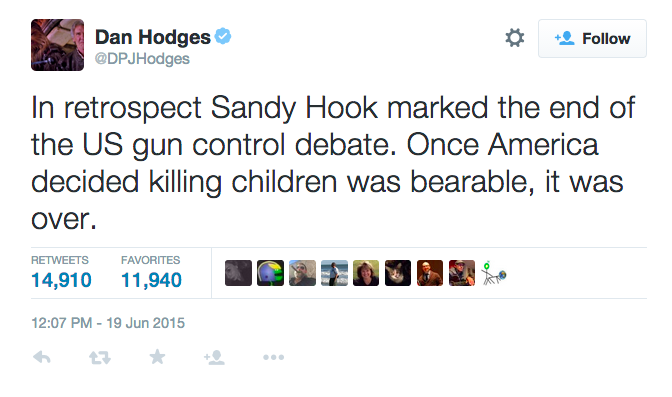
I would like to end with this editorial by Fareed Zakaria in the Washington Post that I read just after posting:

Since 9/11, the United States has responded aggressively to the danger of terrorism, taking extraordinary measures, invading two countries, launching military operations in many others, and spending more than $800 billion onhomeland security. Americans have accepted an unprecedented expansion of government powers and invasions of their privacy to prevent such attacks. Since 9/11, 74 people have been killed in the United States by terrorists,according to the think tank New America. In that same period, more than 150,000 Americans have been killed in gun homicides, and we have done . . .nothing.

Our attitude seems to be one of fatalism. Another day, another mass shooting. Which is almost literally true. The Web site shootingtracker.com documents that in the first 207 days of 2015, the nation had 207 mass shootings. After one of these takes place now, everyone goes through a ritual of shock and horror, and then moves on, aware that nothing will change, accepting that this is just one of those quirks of American life. But it is 150,000 deaths. Almost three Vietnams.

And more from the editorial piece:

It is not an act of fate that has caused 150,000 Americans to die over the past 14 years. It is a product of laws, court decisions, lobbying and pandering politicians. We can change it.

And Timothy Egan writing for the New York Times agrees:

The waves of mass shootings continue to roll over the United States like surf on the ship of state’s prow. Every few weeks now we get hit with a jolt of cold water. We shake and shudder, and then brace ourselves for the next one.

So we beat on — a nation whose people are 20 times more likely to die of gun violence than those of most other developed countries. The only thing extraordinary about mass shootings in America is how ordinary the killing grounds are — elementary schools, high schools, colleges, military recruitment centers, theaters, parks, churches.Is no place safe? Actually, several places are. You want protection in a country that allows a deranged man to get an assault weapon to hunt down innocent people in a public space? Go to the airport — that bubble of gun-free security. Or go to a major-league baseball game, or a stadium in the National Football League. (…)

What we’re moving toward, then, are regions that are safer than others, and public spaces that are safer than others, led by private enterprise, shunning the gun crazies who want everyone armed. The new reality comes with the inconvenience and hassle of screening and pat-downs similar to the routines at airports — enforced gun-free zones, not mere suggestions.

As a way to make everyday life seem less frightening, the new reality is absurd. But that’s the cost, apparently, of an extreme interpretation of a constitutional amendment designed to fend off British tyranny, a freedom that has become a tyranny in itself.

Why background checks on all gun sales are essential

Let's leave our guns in the lobbyUnless you have been living under a rock, on a vacation with no news available or just plain in denial, you know that our nation has been experiencing an epidemic of gun violence that is really not new. This time, however, there seems to be more talk about it and even politicians are being pressed by the media and constituents to talk turkey about gun violence and what to do about it. It’s a topic that most want to avoid. Why? Because if they say what they really know to be true in their heart of hearts, it will p#$$ off the corporate gun lobby and the gun extremists and no one wants to go there. If it p&^%es off the rest of us? Apparently we don’t count and we are the majority. We are the 92% of even gun owners who want our politicians to pass a law to require background checks on all gun sales. I guess we don’t count.

So let’s look at the past month or so.  The shooter of the 9 Black Charleston residents at Mother Emanuel church should not have had a gun. How did he get it? He bought his gun from a licensed dealer after an incomplete background check. This was admitted to the public by the FBI Director:

Comey said the FBI made the error due to a breakdown in the background check system and confusion with paperwork between the FBI, local police departments and county jurisdictions.

Due to Roof’s admission during an arrest in late February that he was in possession of drugs, he should not have been permitted to buy the gun he used in the massacre. However, an agent working for the FBI’s background check system who was performing the review on Roof failed to contact the Columbia, South Carolina, police department which arrested Roof, in part because of a clerical error in records listing the wrong agency.

Because Roof’s background check took longer than three days to complete, the gun shop owner was allowed to sell the gun to Roof. The law permits gun sellers to sell guns if a background check takes longer than three days to complete.

Houston, we have a problem. Lives depend on our fixing this flaw in the background check system brought to us by the corporate gun lobby. This great article in The Trace explains how this happened in the first place:

It was called House Amendment 390, and it radically altered the implementation of the Brady background check bill. It was backed by the NRA. Twenty days later, it was the law. And 22 years later, one of its elements allowed Dylann Roof to get a gun.

Last week, Jim Clyburn, a Democratic Congressman from South Carolina, filed legislation that would close the so-called “default proceed loophole,” which allows federally licensed firearms dealers to proceed with a sale if a background check — as in Roof’s case — takes more than three business days to complete. Connecticut Sens. Chris Murphy and Richard Blumenthal echoed the call, urging President Obama to take executive action to extend the window that federal examiners have for making a determination on a purchaser.

Here is more from this article about how this provision to proceed with a sale after 3 days even without a record of a background check made it into law:

His amendment was initially rejected, but when he tweaked it slightly and requested a floor vote on November 10, 1993, it passed the House 238 to 192, with 122 Republicans and 84 Democrats voting “aye.” The full Brady bill passed the House later that day. When the Senate took up the legislation, lawmakers were faced with Gekas’s one-business-day time limit, which would go into effect five years after Brady’s enactment, along with the instant check system. But after further maneuvering in the Senate, the investigation period was raised to three days.

On the night of November 20, 1993, the Brady Act passed the Senate 63 to 36, with 47 Democrats and 16 Republicans voting yes. President Bill Clintonsigned it into law on November 30.

Charles Schumer, who shepherded the legislation in the House, would later testify about the “tortuous negotiations” necessary to get the Brady bill to Clinton’s desk. Though he called  the instant check provision (which would come to be known as the National Instant Criminal Background System, or NICS) “unworkable,” he conceded that “it was a necessary compromise to pass the most  important gun control legislation since 1968.”

Five days before the bill signing, Wayne LaPierre gave his own assessment of the outcome, reiterating his group’s stance: “The waiting period is unfair to honest, law-abiding people. The criminals won’t wait.” But in actuality, the group had triumphed. It managed to maintain political cover with supporters by fighting an unflinching war against the bill in the public arena while simultaneously watering it down from within. And more than ever before, it proved that it could mobilize its three-million-strong membership in the process.

Ten months before NICS was scheduled to go online, Clinton floated the idea of indefinitely extending the five-day investigation period used by the interim manual background check system. But the Republicans who had taken over control of Congress proved inhospitable to any further alterations.

And so 9 people are dead because of the corporate gun lobby’s totally irrational fear about “law abiding” citizens having to wait to get their guns. What’s the rush I ask?

Regarding the shooting in Chattanooga, there’s so much it’s hard to know where to start. The shooter obtained some guns “legally” whatever that means given his alleged problems with drugs and mental illness. One of the guns was purchased at the on-line site called Armslist.com that connects shooters  buyers with sellers. And yes, this is legal because we have not made it illegal. Until states and the federal government pass laws requiring background checks on all gun sales we will have more of these shootings. Do we care?

( To deflect the real problem of easy access to guns, some state Governors have issued orders for our at home military to be armed. Of course, we now know that at least one of the victims of the Chattanooga shooting was likely armed. Never mind. Armed citizens are showing up at military centers to “guard” our military. I wrote about this one in my last post. It’s not going well so far.)

Every time another of these shootings occur, a whole population of Americans have flash backs and PTSD. It happens. A friend wrote this article about her own experience with gun violence and why the shootings cause her to experience PTSD:

I started working as an activist to prevent gun violence in December 2012 after the devastating shooting at Sandy Hook Elementary school in which a 20-year-old man shot and killed 20 children and six adult staff. I felt I could no longer sit idly by as this epidemic ravaged my country — especially after my own experience more than a decade earlier. My PTSD-fueled visions were turning into nightmares of guns pointing at my own children’s heads. And that’s when I knew I had to do something.

What makes my job so damn hard — aside from the powerful and greedy gun lobby — is that I’m caught in what seems a never-ending cycle of gun-related violence, and it seems I can’t do it. I am caught in a perpetual state of drop-everything-and-rapidly-respond to another shooting.

My typical response, like many I know, is to feel a rush of anger at yet another shooting. Our legislators need to recognize that our system is bleeding — quite literally shot to hell. (…)

But this time, I am not angry. And that scares me. This time I feel helpless and I want to run away. Maybe it’s because I’m hosting a friend from New Zealand where they don’t have the epidemic of gun-related violence like we have here.

It has made me think about moving, about leaving the country.

Imagine what life would be like not having to worry whenever I take my kids to see a movie or send them off to school.

Imagine life without gun violence.

“Imagine a life without gun violence.”

Sigh.

But I digress. I got to thinking about the victims, PTSD, violence, epidemics, hapless politicians, the poisonous corporate gun lobby, my sister, families of victims of domestic violence who I know, families of victims of mass shootings who I know, families of victims of gun suicides who I know……

Where was I?

Oh yes,- the Lafayette theater shooting. The shooter was a prohibited purchaser but supposedly bought his gun legally. What does that mean? Let’s look at this article:

In between, Houser assembled a file that will tell one of two important policy stories when the still ongoing investigations are incomplete. Either Houser will stand as a case study in how far a person can go without being barred from gun ownership — or become the latest reminder of the missing records that hobble the federal background check system. (…)

But on its own, the emergency petition that led to H0user’s stay at West Central would not necessarily prohibit him from gun ownership under the federal law that regards involuntary psychiatric commitments as grounds for banning someone from possessing firearms. For that to happen, a judge must take the next step and order extended hospital time. And for Houser, the records trail (at last for now) goes cold at that critical juncture. The relevant probate records are sealed and cannot be made public by the court.

While Houser’s family was asking that he be committed for psychiatric care, they were also seeking a temporary protective order barring him from any contact with them. That court filing cites “various acts of family violence” and states that Houser’s wife had “become so worried about the defendant’s volatile mental state that she has removed all guns and/or weapons from their marital residence.”  A subsequent, handwritten court record indicates that the temporary protective order was lifted on May 8, 2008. 

Some states have laws that command persons subjected to a protective order to relinquish their guns while the order is in place. Georgia, the state where Houser’s family lives and the order was filed, is not one of them, according to a 2014 report from the Center for American Progress. Houser’s home state of Alabama has a similar lack of restrictions. In 2014, the Louisiana State Legislature passed a law prohibiting the possession of firearms “by persons who are the subject of protective orders or permanent injunctions involving domestic violence.” However, the law only applies to cohabitating spouses and permanent restraining orders. Houser, who was estranged from (but allegedly sometimes stalked) his family and had only a temporary order against him, would not have been affected.

The shooter was denied an Alabama permit to carry a gun in 2006. But:

With the 2013 passage of legislation backed by the National Rifle Association, Alabama went from a “may issue” to a “shall issue” system for concealed carry permits, taking away some of sheriffs’ discretion. And none of the behaviors that led the sheriff’s office to reject his bid for a pistol permit would have caused him to fail a federal background check before buying a gun.

What might — might — have was a judge’s order of involuntary psychiatric commitment, which brings the events of April 2008 back to the fore.

If the judge in the case didn’t order more hospital time, that could explain Houser’s legal gun purchase in 2014. The other possibility: The involuntary commitment was ordered, but the record never made it into the National Instant Criminal Background Check System. Georgia is among the worst performing states when it comes to forwarding mental health records to the federal database, according to an analysis by Everytown for Gun Safety. (Everytown is a seed donor to The Trace.)

2 are dead and at least 7 injured as a result of a fatal flaw in our background check system.

Where is common sense?

Governor Jindal?

Congress?

That’s what I thought. Silence. Denial. Pandering.

Disgusting and shameful.

We are better than this.

Here is what LouisianaGovernor Bobby Jindal, Republican candidate for President, said about gun laws and the loopholes that allowed for the shooter to get his gun:

Gov. Bobby Jindal of Louisiana called for tougher gun laws in other states on Sunday, breaking his silence on the issue three days after a gunman with a history of mental illness and violence opened fire in a movie theater in the state’s fourth-largest city.

Gun control has become a prominent subject on the presidential campaign trail after the shooting on Thursday in Lafayette became the third mass shooting in six weeks in the United States. Mr. Jindal, who received an A-plus rating from the National Rifle Association, is one of 16 candidates seeking the Republican nomination for 2016. (…)

Until Sunday, Mr. Jindal and most of his Republican rivals had deflected questions in recent days over whether the killings reflected a need for tighter gun control laws. On CBS’s “Face the Nation,” Mr. Jindal called for states to adopt laws similar to Louisiana’s that feed information about mental illness into a federal background check system for potential gun buyers.

“I think every state should strengthen their laws,” he said. “Every state should make sure this information is being reported in the background system. We need to make sure that background system is working. Absolutely, in this instance, this man never should have been able to buy a gun.”

Hmmm, OK. We could give Governor Jindal credit for at least attempting to say the right thing under pressure. What he didn’t say might be more important to the discussion. Clearly the Lafayette shooting exposes the flaws in our system brought to us by gun lobby bought and paid for politicians like Jindal. Does he really think we will turn the other cheek and pretend he didn’t just sign into law some of the weakest gun laws in the country? Does he think we don’t know that Louisiana has one of the highest gun homicide and gun death rates in the country? From the linked article above:

The state doesn’t require background checks on private sales, even for assault weapons; doesn’t require gun owners to register their firearms; and doesn’t have a limit on the number of firearms that can be purchased at one time, according to the Law Center to Prevent Gun Violence. As for gun violence, the state has the second-highest gun death rate in the nation, according to an analysis of the latest National Vital Statistics report. Louisiana’s lax oversight also enables firearms trafficking to other states, in which it ranks fifteenth in the nation, and 28 percent of guns wind up in criminals’ hands within two years of sale—almost six points above the national average.

Jindal has worked to weaken the state’s already lax gun control by signing a wave of bills in 2013 and 2014. He broadened the “Stand Your Ground” law to protect shooters who hurt, but don’t kill, someone they feel is threatening. He allowed concealed weapons in places that serve alcohol. He banned public access to the personal information of concealed handgun permit owners. He approved guns in churches. And he allowed Louisianans to apply for lifetime concealed-carry permits.

The hypocrisy oozes out of his mouth. Will he get away with it or will the public and the media keep asking questions and keep making politicians responsible for their own actions.

The time is NOW to talk about our gun violence epidemic. We don’t need lying and pandering. We need action. But of course the gun lobby and its’ bought and paid for politicians think we will believe them when they say the time to talk about gun violence is not after a wave of gun violence. A Washington Post article talks about why now is the time:

There are good reasons for legislative restraint in the aftermath of emotional tragedies. You probably don’t want lawmakers drafting bad legislation in a panic to do something, anything, in response to a public outcry.

On the other hand, as the shootings continue and the body count rises, the inevitable counter-argument becomes: if not now, when? Jindal didn’t want to talk gun laws last month, after Charleston. He doesn’t want to talk about them this month, after Lafayette. It’s only a matter of time before the next national tragedy strikes and sets the national gun clock back to zero again. And it will likely happen sooner than you think.

The Mass Shootings Tracker, a crowd-sourced tally of mass shootings maintained by the GunsAreCool subreddit, shows that we haven’t gone more than eight days without a mass shooting in the U.S. since the start of 2015 — that doesn’t leave a lot of time to grieve and regroup between shootings. We’ve averaged exactly one mass shooting per day since the start of the year. Forty eight days saw more than one mass shooting take place. On 18 days there were at least 3 shootings. On three days this year — April 18, June 13 and July 15 — there have been five shootings. (…) In the end, it often seems that the goal is to put off the conversation about the role of guns in America or quibble about methodology while the number of people killed or injured by guns rises. On the other hand, some people, like the Telegraph’s Dan Hodges, argue that we’ve already had the conversation, and that it’s already over. They may be right.

Here is what Dan Hodges tweeted that got the attention of the writer of the article above:

Screen Shot 2015-07-27 at 12.12.30 PM

Indeed. Have we decided that the massacre of 20 small school children is bearable. What have we become in order to satisfy a well funded corporate gun lobby’s appetite for power, influence and sales of weapons? Have we become the country reflected in the cartoon at the top of this post? The question has to be asked and answered. For what we do about this epidemic of gun violence reflects our values and who we are as a country.

We just have to decide what the price is for our insane gun culture as this writer is wondering: 

How much is one innocent life worth? Ten gun buyers waiting a few minutes longer to purchase a firearm? 25 buyers? 100?

I’m not going to tell you about how other countries have faced similar crises and collectively made the decision to enact reform. We aren’t other countries. As Americans we deal with issues at our own rate based on our own values.

Instead, I’ll point to an issue that the South just tackled: the Confederate flag. Since revisionist historians started to recast the role of the South in the Civil War in the late 1800s, it was pretty much an accepted fact that people were too divided over the flag for anything to ever change.

…and then it did. In a matter of weeks, the Confederate flag was relegated to the dustbin of history in South Carolina and companies that understood its harmful symbolism to so many Americans began pulling products from their shelves.

The change came at the cost of nine more innocent lives, but it happened. (…)

Our lack of action as a country suggests that we don’t value the lives of innocent Americans over the minutes of inconvenience that potential gun buyers might face. So unless we are willing to start telling our elected leaders to pass background check reform, we might as well continue to just haggle over the price of innocent lives.

Lives matter. Laws matter. Background checks or lack thereof matter. The proof is screaming at us. Are we listening?

We could listen to the voices of the victims. How about the video of one of the Lafayette shooting victims, Jillian Johnson, singing with her group in this lovely and moving tribute to her and her life. The victims have names. They have families. They had jobs, husbands, aspirations, opinions….. until suddenly they don’t.

We just have to be better than this.

The aftermath of the Chattanooga mass shooting

puzzle piecesAs always, after mass shootings, people on both sides start offering solutions. The most common sense solution to come from this particular shooting is to expand our background check system to require background checks on all gun sales. Why? It’s just a good idea in general. But the Chattanooga shooter got many of his guns through the Internet site, Armslist.com where buyers and sellers can be connected to make gun sales.

You can check what guns are available for sale in your own state or city by clicking on the site and going to your state. Then you can click on private party and see that many, if not most, of the guns sold on this site are sold by private parties where background checks are not required. That’s just crazy. I checked on my own state of Minnesota for today and here is what I found. There are 6 handguns listed for sale for today, all from private parties.

Clearly we have a problem. The interesting thing about Internet sales is that the gun rights extremists are in denial about how they work. They make claims that all guns purchased on the Internet have to be picked up at a federally licensed firearms dealer. That, of course, is only for those purchased at a gun dealer on-line. The sites like Armslist are for connecting buyers with sellers and so have no requirement that background checks will be required. This is a dangerous market place for selling guns and we know that other shooters have bought guns from this site. If we don’t do anything about this, more dangerous people will purchase guns this way and it will be legal because we have not made it illegal. That is unacceptable. Lives can be saved. Not to do so by stopping these kinds of sales is not only irresponsible, it is negligent.

It’s vitally important to look towards background checks to save lives. The Charleston shooter who massacred 9 innocent black people in a church, should not have been able to purchase his gun. But an error in our FBI NICS system allowed the sale to go through. Had he been unable to get that gun at the gun dealer, he could easily have used a private sale on an Internet site or found a private seller at a gun show or other venue. This is not a puzzle. It’s solvable. Let’s put the pieces together.

Instead, the other solution now in the news is to arm all state side military members so they can protect themselves. There are many reasons why this is NOT a good idea. This article from The Trace explains it”:

Most service members — 99 percent of airmen, 88 percent of sailors, and about two-thirds of soldiers and Marines — are not in direct combat roles, but instead are technical workers whose specialties support those “tip of the spear” troops. These include navigators, supply clerks, water purification specialists, and camera crews. Roughly the same breakdown applies to the backgrounds of recruiters and reservists. Practically speaking, this means that your average military member’s firearms experience may only go as far as some boot camp familiarization with a service rifle on a “static range,” plinking at paper targets to qualify for a marksmanship ribbon. Some servicesare more stringent than others — “every Marine is a rifleman,” the old saw goes, but even most Marines only qualify annually in the narrow realm of target marksmanship, not tactical handgunning or law enforcement uses of firearms. Civilians may believe that all members of the military are “stone-cold killer weapons experts,” as former Army Special Forces officer and Pentagon official Steven P. Bucci told the Boston Globe, but their files say otherwise.

The upshot is that your average service member is more qualified than most civilians to handle guns, but no more qualified to neutralize an active shooter than the average professional mechanic is to race the Daytona 500.

And they don’t need to be, because most military sites have dedicated baseDepartment of Defense police and military members like MPs and masters-at-arms who specialize in armed law enforcement. (…) The result of all of the above: Hardly any military office meets the definition of a “gun-free zone,” but every military office does observe strict discipline on gun use. “Arming DoD personnel with firearms shall be limited and controlled,” the policy states, limiting armaments to “qualified personnel” — those who apply and qualify to carry weapons, then undergo special training — “when required for assigned duties and there is reasonable expectation that DoD installations, property, or personnel lives or DoD assets will be jeopardized if personnel are not armed.” When determining if those conditions are met, commanders are required to consider “the possible consequences of accidental or indiscriminate use of those arms.”

And more about why arming all military as a bad idea just as arming all citizens is ( from the article):

That’s to say nothing of other shootings — such as the 2013 Navy Yard murders or multiple fatal killings at Fort Bragg, home of the Army’s airborne and special forces — perpetrated by the very same uniformed and civilian military personnel that conservatives seek to arm. Dating back to 1994, there had been 20 shootings on or around military installations before the Chattanooga tragedy. All of them were committed by disgruntled uniformed or civilian military workers. As one Navy training brief on active-shooter situations points out: “Most attackers had no history of prior violent or criminal behavior.”

Beyond the practical concerns about an increase in accidents and criminal killings, military planners have another reason to be sanguine about arming service members en masse: It poses an inherent risk to civil liberties in the United States. Since the late 1800s, the Posse Comitatus Act has limited the federal government’s ability to use military members to carry out domestic law enforcement duties. It originated in the rollback of Reconstruction-era policing of the South, but since then, the law has been widely praised as a safeguard against federal martial law on the streets of America. Second Amendment advocates who often defend personal firearms ownership as a check against government abuse and tyranny would likely be among the first Americans to criticize arming domestic military members wholesale in the name of “security.”

Isn’t this exactly what the gun rights extremists are afraid of? A heavily armed government is going to come for their guns. There will be tyranny so they prepare themselves by arming up. Perhaps the “solution” to arm all military who serve in non combat roles in our own country will give the gun nuts even more fuel for their crazy and paranoid ideas about the government surely out to get them. This will drive up gun sales yet again. It’s a vicious circle for sure.

And the article ends with the obvious:

But arming all military workers everywhere is not one of those sensible new measures. At best, it’s the gut feeling of a car repairman in Connecticut and the political stumpers that pander to him; at worst, it’s the xenophobic expression of pathos by conservative chickenhawks. One of their more ornery (or, possibly, more honest) spokesmen, actor and right-wing activist James Woods, displayed the latter sensibility on Twitter last week. “Chattanooga exposes AGAIN several liberal fallacies,” he wrote. “‘Gun free zones’ are ‘safe’; military shouldn’t be armed; POTUS cares about military.”

This is a particular gun-loving, Islam-fearing ideology taken to its logical conclusion. By this logic, every inch of public space in America is an active battleground, and every American who opposes the militarization of that space (including war-worn Army brass like Odierno) hates America and its troops. It is precisely the sort of emotional argument for a perpetual combat footing that shouldn’t be mixed with lethal weaponry, proffered by precisely the sort of sideline sitters who would never take part in the war. Actual military security experts know better.

Having an armed American is just not going to make us safer. We need to come up with other solutions to the problem of armed people who shouldn’t be on the ready to attack military facilities, movie theaters, schools, shopping malls, and churches.

This does not have to be a puzzle. The pieces fit if we make them and have the will to work on it. But so far, even after the recent mass shootings in Charleston and now Chattanooga, we are not doing what needs to be done for public health and safety.

Proactive and preventative measures, like background checks for all guns sales,  have the most chance of saving lives. It’s time for us to get to work to stop the next mass shooting and the next domestic shooting and the next time someone shoots a disabled veteran with his own gun while he is guarding sea turtle nests. Our insane gun culture, thanks to the corporate gun lobby and its’ bought and paid for politicians, is coming home to roost. It’s time for a change. Let’s get to work for we are better than this.

And I would be remiss if I did not ask for a moment to think about the victims of the Aurora theater shooting, 3 years ago today. The shooter was just found guilty by a jury just last week so the families have had some sense of relief. But today, they remember the 12 of their loved ones who were shot dead by a young man who should not have had access to guns and ammunition. And 70 more were wounded.