Reactions and inertia after too many shootings

inertiaOnly in America do we have 24/7 coverage of high profile shootings happening weekly or more often without the accompanying obvious national discussion about solutions. We lurch from one shooting to the other in just a few hours or days. Our Congress is hoping that people will forget about the daily carnage and not push them to do anything about it. It seems to be working if the goal is to ignore a very serious public health and safety epidemic. Inertia sets in. But the shootings continue unabated. It’s hard to even know where to begin.

Tomorrow will be the one year anniversary of the shooting of Michael Brown by police officer  Darren White in Ferguson, Missouri. How can we forget that time period after the shooting and the verdict of the grand jury to not charge White for the shooting, when Ferguson erupted and we all watched the damage happening before our very eyes? It was the birth of Black Lives Matter– a movement that continues to occupy space in our political and social networks. The fact that we even have to name a movement with this name says everything about where our country is in regards to racial justice issues.

What has happened since the Ferguson shooting of a black youth by a police officer? Since Ferguson, unfortunately “officer involved shootings” continue.  I am not making any accusations here aside from reporting the incidents.

There’s the Tamir Rice shooting.

There’s the shooting of Walter Scott.

According to this source, there were 100 shootings by officers of unarmed black people in 2014.

So this one just happened. An officer near Dallas shot an unarmed college football player an altercation that will get more investigation.

And officers themselves are being shot at and shot in increasing numbers.

Too many guns mean too many shootings. Officers in other democratized countries don’t carry guns for the most part, but then neither do citizens:

The US, to be sure, is a different country. Some argue that the ubiquity of guns in America is a major reason that many seemingly innocuous incidents escalate into fatal shootings. At the same time, racial tensions in the US are more pronounced than in many other countries. Yet analysts believe that other nations have adopted a number of practices that contribute to less-contentious relations between police and residents – and might make a difference on US streets. These range from more-rigorous police training, to changing the way officers interact with residents, to requiring more education for cops.

The thing is, shootings are happening all over America every day. 88 lives are taken by gunshot injuries daily. For young black males, homicides are taking way too many lives:

For most young adults, aged 20 to 24, the No. 1 cause of death is car accidents, according to data from the Centers for Disease Control. For black men in that age group, though, the top cause of death is gun violence; they are four times more likely to be shot and killed than they are to die in a car accident.

A young black man is nearly five times more likely to be killed by a gun than a young white man and 13 times more than an Asian American man. These numbers, dramatic as they are, actually understate the problem. If a black person is killed by a gun, it is judged a homicide 82 percent of the time. For the broad population, most gun deaths are ruled accidental or the result of suicide; only 34 percent of gun deaths are attributed to murder. (…) For all other races, the gun homicide rate went up in the 1990s, though not much, and then it came back down. For young black men, it more than doubled and still hasn’t completely recovered to earlier levels.

This is an American tragedy. Young black males are being killed in great numbers. Way too often we read about the shootings of gang members by other gang members in our large urban areas. Sometimes the bullets kill innocent people in cross fire. And we read about young black men who have accessed guns they may believe they need to protect themselves in their violent neighborhoods. It’s a vicious circle of violence.

Why are we not asking how these young people get their guns? A very sad story in St. Paul, Minnesota about a 16 year old black teen who was shot and killed by a gun permit holder in a robbery attempt highlights the stolen gun problem in our country that contributes to many crime guns. The victim had become a violent teen, involved in gang activity and crime. He and his “friends” had stolen a car earlier the day of the shooting that contained 2 loaded guns. This is a sad story all the way around. The shooter did appear to act in self defense and will apparently not be charged.

But what can we say about the guns stored in a car that ended up in the hands of a 16 year old who shouldn’t have guns? If we are to solve the problem of too many shootings, it is important to understand where the guns used in shootings come from in the first place. In this case, a 16 year old boy obtained a gun from someone else’s car. Every gun in the hands of a child or teen must first pass through the hands of an adult. The permit holder appeared to act in a responsible way though the investigation continues. He made sure a “911” call was made and then he tried to help the teen. The owner of the stolen car? Perhaps he will think twice about storing guns in a car away from himself where he could better keep an eye on them.

Stolen guns, according to this article, account for 10-15% of crime guns. The article then goes on to state that straw purchases actually provide the majority of crime guns. There was a recent case, also in Minnesota, of a woman straw purchasing guns for a Somali gang who used the guns in a crime spree in the Twin Cities area:

For months, authorities say, a young woman calmly walked into a Robbinsdale gun store and legally bought guns big and small, including a Lady Lavender model Charter Arms .38-caliber revolver.

She apparently didn’t keep them long. Investigators say she quickly — sometimes immediately — turned the weapons over to Fausi Mohamed, a member of the well-known Somali Outlaws gang, and some were used in a violent crime spree across the Twin Cities this summer. (…)

The federal search warrant states that there is probable cause to believe that between February and June the woman and Mohamed had unlawfully and knowingly made false oral and written statements intended to deceive the gun dealer about the lawfulness of the sale of firearms.

Charges are fairly uncommon against straw buyers, people who buy guns legally on behalf of people who cannot. But gang-related crimes involving guns bought that way are a recurring theme. In November, U.S. Attorney Andy Luger charged members of two rival Minneapolis gangs for receiving illegal guns used in some 15 killings or shootings.

A mentally unstable man who was shot and killed after firing at officers at New Hope City Hall in January received a gun from a straw buyer.

The Minnesota legislature voted to strengthen the Minnesota straw purchase law in another gun bill that passed and was signed by Governor Dayton.  This is timely given what is happening in real time. Gun laws can make a difference one way or the other. So when the gun lobby and the gun extremists say that stronger laws won’t make a difference, they are not telling the truth.
When there are so many guns in circulation it makes sense that there are more shootings and more gun crimes. Police officers are shooting people. People are shooting police officers. Gangs are shooting at themselves and others. Some officers and citizens are shooting at gang members. Young white males are shooting up movie theaters, schools, shopping malls, schools and churches. Older white males are also doing some of the mass shootings. People with anger issues can get guns and shoot others over things that shouldn’t result in death. People who are dangerously mentally ill can easily access guns and shoot up theaters or public shopping malls during a “Congress on your corner” event.
Men with domestic abuse charges or orders for protections can get guns and shoot their spouses, partners. Teens can access guns to kill themselves or others. Small children can find guns in their homes or the homes of others and shoot themselves, a sibling or a friend. People can discharge guns at a Ronald McDonald house where family can stay while a loved one undergoes cancer treatment. Dads can shoot their daughters while giving them gun safety lessons. And no arrests in either case. Good grief. Where is common sense? And where are responsible gun owners?
If this doesn’t sound like the definition of insanity, I don’t know what does. We have timid reactions to the many shootings in America because we are afraid to offend the corporate gun lobby. When money and votes are given in exchange for not passing common sense gun laws, that is insanity. Inertia sets in. Let’s move on shall we? We would hate to inconvenience our politicians with the raw facts and the names and faces of the victims.
Facts and research into the causes and effects of gun violence would be hugely important to discussing the problems and the solutions. If only the gun lobby hadn’t bottled up funding for the CDC to keep the agency from studying gun violence. 
Sigh.
But others have stepped in. This blog post at Armed With Reason discusses the insistence by the corporate gun lobby that if only we do something about those with mental illness we will solve our nation’s gun violence problem. This is their immediate reaction and if left alone without fact checking, it will be believable. But it’s not true. Let’s take a look from the post:

Additionally, in 2015, Wintemute discovered that firearm owners who drink excessively had a history of risky behavior, including higher rates of non-traffic offenses, an overall higher risk of arrest, and greater reported “trouble with the police.” Alcohol abuse, the 2011 study found, also leads to risky behavior with guns: For instance, alcohol intoxication is likely to impair a firearm owner’s “decision-to-shoot” judgment. And while Wintemute didn’t seek a direct link between alcohol abuse and gun violence, he did conclude that of the nearly 400,000 firearm-related deaths between 1997 and 2009, “it is probable that more than a third of these deaths involved alcohol.”

These findings have profound implications for crafting policy to avert future tragedies. In the wake of mass shootings, politicians from both sides of the aisle often call for including better mental health records in background checks. Though a worthwhile sentiment, the evidence suggests that these efforts would be better spent focusing on alcohol abuse instead.

Don’t let a red herring cause inertia in the important discussion about gun violence prevention. We need to be “armed” with research and facts.

We can do a lot more to make a difference in lowering gun deaths and injuries and the number of shootings. Some stronger laws have been passed and some weaker laws have been passed. They are all addressing issues mostly on the fringes of our gun laws but don’t get to the core of our problem with the proliferation of guns and the increased number of shootings. What about the suggestion offered by this writer to allow loaded guns inside of our national Capitol and the offices of our Representatives and Senators? Good idea? From the article:

These issues have not gained traction in Congress and this inertia claims responsibility for deaths. Political obstinacy has brought the issue into funeral homes across the nation. Congressional silence and inaction regarding the epidemic of gun violence have veered our gun control conversation rightward. Now, in too many states, white supremacists, mentally ill ideologues, and other threats to safety may purchase guns at their leisure. Inaction has acted to create a nation where hardly any person, save perhaps a Senator, can claim safety from a rogue gunman’s bullets. Moviegoers. Churchgoers. Malls. Elementary schools. Sikh temples. University students. Spas. This list, already extensive, excludes those people of color targeted every day by law enforcement agents. Most Americans do not have the capitol police, the secret service, and innumerable bodyguards to protect them from insane,predominantly white male mass shooters. Certainly they do not have the protection of a Congress whose tenderheartedness has been purchased by the National Rifle Association.

These Senators, so absolutely committed to extensive gun proliferation, should favor such measures. They have not thought fit to vehemently object to unthinkable access to guns in their constituents’ hometowns. What sets apart the Capitol building? The Congressional offices, for that matter? If NRA-owned senators truly believe in practically uninhibited access to guns and gun-positive spaces, they should extend that freedom to grateful constituents knocking on Congress’ literal doorstep, regardless of any potential security concerns. Proper senatorial self-defense lessons could certainly assuage any fears. Indeed, Sen. Rand Paul (R-KY) believes that a gun-carrying teacher could have prevented the Sandy Hook elementary school atrocity. Sen. Paul should then support mandatory mass-shooting bystander training for all senators. Perhaps then, when someone inevitably – as inevitably as they have in countless public spaces in this country – pulled a gun on the Senate floor, Sen. Paul could put his advice to use.

Why not? There are few public places where guns are actually not allowed. In general schools remain “gun free zones” but efforts to change that have been successful in some states. Luckily for the country, many of these proposals have been turned down because of the common sense thinking that our children really don’t need to see adults in their schools carrying guns around. There is no proof that this would work and, in fact, in instances of mass shootings, it is very rare that an armed citizen has stopped one.

Other “gun free zones” are allowed under state carry laws, such as some public buildings, private businesses, colleges and universities, hospitals, sports venues, etc. The gun extremists will say that posting a sign won’t stop them from carrying inside. Great. It won’t stop anyone from bringing a gun inside actually. But think about it. I recently attended a Minnesota Twins baseball game. There were metal detectors and paid employees checking bags and purses similar to airport screenings. So the safest places in our country are professional sports venues, airports and the US Capitol and office buildings.

The gun lobby of course, wants guns in all of these places. Why not? Because surely only law abiding citizens will carry their guns inside and if someone who is not law abiding dares to bring a gun in and attempt a shooting, those law abiding citizens will be in the right place at the right time to defend us all from being shot.

Consider this- who will defend children in their homes, not considered to be “gun free zones” since anyone can buy a gun and bring it home with them? Every day in America an average of 8 children die from gunshot injuries due to homicide, suicide or an “accidental “shooting. I write about them often on this blog. Here’s just one recent incident of an “accidental shooting” of a child in the state of Alaska where there are more gun owners than almost any other state and some of the weakest gun laws.

Who will save women from domestic shootings in their homes? For that is most often where they take place. Homes are not “gun free zones”.

Who will save us from ourselves? Police shootings or “officer involved shootings” are the highest in the US of any other high income country. Young black men are losing their lives in great numbers in our large urban cities in alarming numbers. Our streets are not “gun free zones.” Suicide by gun accounts for the majority of gun deaths in America. Many of these, again, occur in homes where guns are available and accessible. Some of these are mass shootings where the shooter shoots himself ( mostly male shooters).

Gun deaths and shootings are on the rise. Obviously the solution is not to allow more guns for more people in more places. We are over saturated with guns, many owned by law abiding citizens and almost all, if not all, originally legal gun purchases. More guns are accessible to more people who shouldn’t have them than in any other high income country not at war.

No solutions are genuinely offered by those in charge of public safety. Instead, many of these folks in charge of our safety are voting in favor of weakening our gun laws in the face of rising numbers of dead Americans. And they don’t seem to care. The solutions will have to come from the public who favor doing something about our national gun violence epidemic. Don’t just sit there chewing on weeds. Get up and do something and demand a vote in Congress for a stronger background check system that could save lives.  That’s a start in the right direction.

Lions and gun violence

lion killingWell, I didn’t expect that posting this meme would cause such a heated discussion on my Facebook page- amongst my friends. The killing of Cecil, the lion, by a Minnesota dentist has provoked some amazing emotions. The media is on it. It’s a controversy for sure. And people are demanding action. Great. I think it deserves the attention it is getting and  potential solutions. And it looks like the Minnesota hunter has not exactly been a responsible hunter.

Meanwhile, back to the people who live in our communities, the killings and injury of human Americans continues. A writer in Colorado wonders why parents who leave their loaded guns out for small children to access are treated differently than those who leave their cars running in the cold. From the article:

This is so wrong. The punishment for leaving your car running in Aurora is far more severe than the penalty for leaving a gun lying around — even if a child finds it and shoots another kid with it. (…)

But in Aurora, you can leave a gun and ammunition in a house with kids, tucked out of sight, and rest assured the Arapahoe County District Attorney’s office won’t prosecute you, even if your own kid finds the gun and accidentally shoots himself or someone else with it.

Last week, Arapahoe County Assistant District Attorney Mark Hurlbert said that office would not file charges against an Aurora man whose 12-year-old son found his father’s gun inside a coat pocket, discovered the bullets elsewhere in the house, got the gun out when he had some pals over and his parents weren’t home, and ended up inadvertently shooting a 7-year-old boy in the head two weeks ago.

The younger boy was critically injured, but his condition nor prognosis aren’t particularly clear, other than he is expected to survive.

Hurlbert said there isn’t enough evidence to charge either the boy who fired the gun while playing with it, nor his father, who said he had no idea that his son even knew there was a gun in the house. (…)

About half of the more than 1 million homes with children and guns in the United States don’t have locked and unloaded weapons. And a report by Everytown for Gun Safety cites an unnerving but hardly surprising Harvard University survey of children in homes with guns. The study reveals that “more than 70 percent of children under age 10 knew where their parents stored their guns — even when they were hidden — and 36 percent of the children reported handling the weapons.”

Even though the Arapahoe County DA considers keeping a gun in a coat pocket good enough security to avoid criminal charges, clearly that strategy isn’t good enough to keep kids from getting injured or killed.

Kids know where guns are “hidden”. My own kids have told me recently that they knew where my husband’s hunting guns were hidden. This was before I got involved in gun violence prevention advocacy. We purchased a gun safe when more awareness about gun violence and the tragic shooting death of my sister caused us to be hyper aware of the dangers of guns in the home. I have provided videos and other information on this blog showing how kids find guns no matter what anyone tells them. They hold them. They play with them. They aim them. And then sometimes they shoot them and kill or injure someone.

Where is common sense? In America is it so lacking that it would be laughable if it weren’t so sad and tragic.

Back to the article above- the writer poses a very good question. Why are gun owners treated differently than others when it comes to negligence? What is wrong with our country? We are outraged and enraged over a man who allegedly shot a lion illegally in Zimbabwe. But when a father irresponsibly leaves his gun out for a child to access leading to a shooting? Not so much. This is the definition of insanity. We have our priorities backwards to say the least.

Last night, my friends Sandy and Lonnie Phillips were on The Rachel Maddow Show talking about the gun industry immunity law or Protection of Lawful Commerce in Arms. After their daughter was murdered in the Aurora, Colorado movie theater shooting, they filed a law suit against the on-line ammunition dealers who sold the shooter his thousands of rounds of ammunition, protective body armor, explosives, etc. When the suit came before a judge, it was dismissed and not only that, because of the Colorado law, modeled after the federal law ( brought to us by the corporate gun lobby) they were ordered to pay the costs of the companies to the tune of over $200,000:

[Holmes] bought steel-jacketed ammo that went through the chairs of the theater, went through the walls of the theater into the theater next door. [He] hit my daughter, who was hiding behind a seat…one bullet hit her in the head and created a five-inch hole…and blew her brains out,” Sandy Phillips said.

Phillips questioned why a bullet with such velocity wasn’t more regulated, and why a person ordering 4,000 rounds wasn’t questioned about needing so much ammo. She also said Holmes was not required to show his license to verify that he was of age to legally make those purchases.

This was not a lawsuit about propaganda  ( as the judge proclaimed) or political gain. This was a law suit about our terribly flawed system of gun laws that allow just about anyone to purchase weapons and deadly ammunition on-line ( and in other venues) with no background checks or no questions asked. When profits come before protecting human lives, this is the result. Victims and families of shootings are treated differently because of the ever influential hold on our political system by one powerful industry and the lobbyists who represent them. It’s a uniquely American tragedy.

Once this many Americans are massacred over and over and over, it’s too late really to have the discussion. It’s too late for the Phillips’. It’s too late for the parents of the children who were murdered in cold blood at Sandy Hook elementary school. Now is certainly the time to discuss this controversial issue even if the NRA folks and others in the corporate gun lobby would love to have it go away. It won’t. Here’s why we need to talk about this issue now and after every mass shooting and every other shooting- in other words- every day:

Warren is right. The only deaths in America we must not discuss or address with any urgency are those caused by guns.

We saw this insane sentiment on display last week after the latest mass shooting – this one in Lafayette, La., where a demented 59-year-old drifter shot and killed two young women and injured nine others in a movie theater.

In the immediate aftermath, Louisiana Gov. Bobby Jindal made one thing perfectly clear. “The best thing we can do across Lafayette, across Louisiana, across our country, is come together in thoughts, in love, in prayer,” Jindal said the night of the shooting.

Asked about what this meant for changing his state’s gun laws (among the weakest in the nation), Jindal pushed back hard. “Let’s focus on the victims right now,” he said. “Let’s focus on their recoveries. There’ll be a time, I’m sure folks will want to jump into the politics of this. Now is not the time.”

Jindal is not alone in his desire to stall and procrastinate after a mass shooting. He’s only repeating the standard Republican/NRA mantra after similar tragedies: Now’s not the time. This is a period for mourning and prayer. There will be time to talk about how to address the problem later, but not while people are burying their dead. For now, let’s pray for them and hug our kids.

Again, why are gun deaths treated differently than other national tragedies or incidents that harm others and/or the environment? Our insane gun culture has become a national tragedy in itself. More from the article:

Funny, I don’t recall Jindal suggesting anyone wait a week to start discussing how to address the Deepwater Horizon explosion in April 2010, which killed 11 people (most of them his constituents).

Immediately after that disaster, Jindal demanded immediate action on “three challenges: stopping the leak, protecting the coast and cleaning the coast.” No one suggested that Jindal’s quick call to clean up the Louisiana coast was a “shameful” effort to “score cheap political points.”

Instead of prayers, Jindal demanded prompt action. “Officials at the Coastal Protection and Restoration Authority are also working with the state’s oil spill coordinator’s office to monitor any potential environmental impact,” Jindal saidwithin 24 hours of the explosion.

After the Sept. 11, 2001, terrorist attacks, did anyone suggest we should wait a few weeks to pray and mourn before responding to the terrorists who murdered thousands?

On the night of the attacks, then-President George W. Bush appeared on national television to vow swift action. “I have directed the full resources of our intelligence and law enforcement communities to find those responsible and to bring them to justice,” Bush said that night. “We will make no distinction between the terrorists who committed these acts and those who harbor them.”

Did Jindal or anyone else suggest that Bush was politicizing these murders by vowing to avenge them?

The answer is NO. The answer about delaying the gun violence discussion is also NO.

What we need to discuss for sure and at the least is one of the serious flaws in our background check system. That would be the “default proceed” with a sale of a gun after 3 days even after the background check has not been completed. This is the flaw that led to the Charleston shooter getting his gun. 9 people are dead as a result. Is that enough to get us talking about solutions to the national gun violence epidemic?

So yes, let’s talk about poaching animals and killing wild animals illegally. The people of Zimbabwe are even puzzled over the outrage given all of the pressing problems that exist where they live:

“It’s so cruel, but I don’t understand the whole fuss, there are so many pressing issues in Zimbabwe — we have water shortages, no electricity and no jobs — yet people are making noise about a lion?” said Eunice Vhunise, a Harare resident. “I saw Cecil once when I visited the game park. I will probably miss him. But honestly the attention is just too much.”

An economic meltdown over the last few years has closed many companies and left two thirds of the population working in the informal economy while battling acute water and electricity shortages.

Most people questioned in downtown Harare hadn’t actually heard about the lion and said they were too busy trying to make a living to care about it.

Water shortages, no jobs, an economic meltdown and the killing of a lion. Up to the Lafayette theater shooting, according to the “mass shooting tracker”, there had been 204 mass shootings in 204 days of 2015. Stunning. Even if you use a different definition of mass shootings, there is no question where the outrage should be directed in America. Since the Lafayette shooting occurred one week ago, 626 Americans have died of gunshot injuries and many more than that have been injured by bullets. Where is the outrage?

Let’s also remember that we are the country that let the massacre of 20 first graders happen with no solution to the problem. We moved on. And then more innocent people were killed. What will we tolerate? We don’t like the killing of a beoved lion in a foreign country because the hunter lured the lion out of a reserve that was protecting it and then killed it. How do we feel about shooters opening fire on innocent people in movie theaters  or schools or military bases or college campuses on purpose for no apparent reason other than they could? I know how I feel.

We are better than this. Let’s get to work and have the discussion and pass laws that will make a difference.

I would like to end with this editorial by Fareed Zakaria in the Washington Post that I read just after posting:

Since 9/11, the United States has responded aggressively to the danger of terrorism, taking extraordinary measures, invading two countries, launching military operations in many others, and spending more than $800 billion onhomeland security. Americans have accepted an unprecedented expansion of government powers and invasions of their privacy to prevent such attacks. Since 9/11, 74 people have been killed in the United States by terrorists,according to the think tank New America. In that same period, more than 150,000 Americans have been killed in gun homicides, and we have done . . .nothing.

Our attitude seems to be one of fatalism. Another day, another mass shooting. Which is almost literally true. The Web site shootingtracker.com documents that in the first 207 days of 2015, the nation had 207 mass shootings. After one of these takes place now, everyone goes through a ritual of shock and horror, and then moves on, aware that nothing will change, accepting that this is just one of those quirks of American life. But it is 150,000 deaths. Almost three Vietnams.

And more from the editorial piece:

It is not an act of fate that has caused 150,000 Americans to die over the past 14 years. It is a product of laws, court decisions, lobbying and pandering politicians. We can change it.

And Timothy Egan writing for the New York Times agrees:

The waves of mass shootings continue to roll over the United States like surf on the ship of state’s prow. Every few weeks now we get hit with a jolt of cold water. We shake and shudder, and then brace ourselves for the next one.

So we beat on — a nation whose people are 20 times more likely to die of gun violence than those of most other developed countries. The only thing extraordinary about mass shootings in America is how ordinary the killing grounds are — elementary schools, high schools, colleges, military recruitment centers, theaters, parks, churches.Is no place safe? Actually, several places are. You want protection in a country that allows a deranged man to get an assault weapon to hunt down innocent people in a public space? Go to the airport — that bubble of gun-free security. Or go to a major-league baseball game, or a stadium in the National Football League. (…)

What we’re moving toward, then, are regions that are safer than others, and public spaces that are safer than others, led by private enterprise, shunning the gun crazies who want everyone armed. The new reality comes with the inconvenience and hassle of screening and pat-downs similar to the routines at airports — enforced gun-free zones, not mere suggestions.

As a way to make everyday life seem less frightening, the new reality is absurd. But that’s the cost, apparently, of an extreme interpretation of a constitutional amendment designed to fend off British tyranny, a freedom that has become a tyranny in itself.

Why background checks on all gun sales are essential

Let's leave our guns in the lobbyUnless you have been living under a rock, on a vacation with no news available or just plain in denial, you know that our nation has been experiencing an epidemic of gun violence that is really not new. This time, however, there seems to be more talk about it and even politicians are being pressed by the media and constituents to talk turkey about gun violence and what to do about it. It’s a topic that most want to avoid. Why? Because if they say what they really know to be true in their heart of hearts, it will p#$$ off the corporate gun lobby and the gun extremists and no one wants to go there. If it p&^%es off the rest of us? Apparently we don’t count and we are the majority. We are the 92% of even gun owners who want our politicians to pass a law to require background checks on all gun sales. I guess we don’t count.

So let’s look at the past month or so.  The shooter of the 9 Black Charleston residents at Mother Emanuel church should not have had a gun. How did he get it? He bought his gun from a licensed dealer after an incomplete background check. This was admitted to the public by the FBI Director:

Comey said the FBI made the error due to a breakdown in the background check system and confusion with paperwork between the FBI, local police departments and county jurisdictions.

Due to Roof’s admission during an arrest in late February that he was in possession of drugs, he should not have been permitted to buy the gun he used in the massacre. However, an agent working for the FBI’s background check system who was performing the review on Roof failed to contact the Columbia, South Carolina, police department which arrested Roof, in part because of a clerical error in records listing the wrong agency.

Because Roof’s background check took longer than three days to complete, the gun shop owner was allowed to sell the gun to Roof. The law permits gun sellers to sell guns if a background check takes longer than three days to complete.

Houston, we have a problem. Lives depend on our fixing this flaw in the background check system brought to us by the corporate gun lobby. This great article in The Trace explains how this happened in the first place:

It was called House Amendment 390, and it radically altered the implementation of the Brady background check bill. It was backed by the NRA. Twenty days later, it was the law. And 22 years later, one of its elements allowed Dylann Roof to get a gun.

Last week, Jim Clyburn, a Democratic Congressman from South Carolina, filed legislation that would close the so-called “default proceed loophole,” which allows federally licensed firearms dealers to proceed with a sale if a background check — as in Roof’s case — takes more than three business days to complete. Connecticut Sens. Chris Murphy and Richard Blumenthal echoed the call, urging President Obama to take executive action to extend the window that federal examiners have for making a determination on a purchaser.

Here is more from this article about how this provision to proceed with a sale after 3 days even without a record of a background check made it into law:

His amendment was initially rejected, but when he tweaked it slightly and requested a floor vote on November 10, 1993, it passed the House 238 to 192, with 122 Republicans and 84 Democrats voting “aye.” The full Brady bill passed the House later that day. When the Senate took up the legislation, lawmakers were faced with Gekas’s one-business-day time limit, which would go into effect five years after Brady’s enactment, along with the instant check system. But after further maneuvering in the Senate, the investigation period was raised to three days.

On the night of November 20, 1993, the Brady Act passed the Senate 63 to 36, with 47 Democrats and 16 Republicans voting yes. President Bill Clintonsigned it into law on November 30.

Charles Schumer, who shepherded the legislation in the House, would later testify about the “tortuous negotiations” necessary to get the Brady bill to Clinton’s desk. Though he called  the instant check provision (which would come to be known as the National Instant Criminal Background System, or NICS) “unworkable,” he conceded that “it was a necessary compromise to pass the most  important gun control legislation since 1968.”

Five days before the bill signing, Wayne LaPierre gave his own assessment of the outcome, reiterating his group’s stance: “The waiting period is unfair to honest, law-abiding people. The criminals won’t wait.” But in actuality, the group had triumphed. It managed to maintain political cover with supporters by fighting an unflinching war against the bill in the public arena while simultaneously watering it down from within. And more than ever before, it proved that it could mobilize its three-million-strong membership in the process.

Ten months before NICS was scheduled to go online, Clinton floated the idea of indefinitely extending the five-day investigation period used by the interim manual background check system. But the Republicans who had taken over control of Congress proved inhospitable to any further alterations.

And so 9 people are dead because of the corporate gun lobby’s totally irrational fear about “law abiding” citizens having to wait to get their guns. What’s the rush I ask?

Regarding the shooting in Chattanooga, there’s so much it’s hard to know where to start. The shooter obtained some guns “legally” whatever that means given his alleged problems with drugs and mental illness. One of the guns was purchased at the on-line site called Armslist.com that connects shooters  buyers with sellers. And yes, this is legal because we have not made it illegal. Until states and the federal government pass laws requiring background checks on all gun sales we will have more of these shootings. Do we care?

( To deflect the real problem of easy access to guns, some state Governors have issued orders for our at home military to be armed. Of course, we now know that at least one of the victims of the Chattanooga shooting was likely armed. Never mind. Armed citizens are showing up at military centers to “guard” our military. I wrote about this one in my last post. It’s not going well so far.)

Every time another of these shootings occur, a whole population of Americans have flash backs and PTSD. It happens. A friend wrote this article about her own experience with gun violence and why the shootings cause her to experience PTSD:

I started working as an activist to prevent gun violence in December 2012 after the devastating shooting at Sandy Hook Elementary school in which a 20-year-old man shot and killed 20 children and six adult staff. I felt I could no longer sit idly by as this epidemic ravaged my country — especially after my own experience more than a decade earlier. My PTSD-fueled visions were turning into nightmares of guns pointing at my own children’s heads. And that’s when I knew I had to do something.

What makes my job so damn hard — aside from the powerful and greedy gun lobby — is that I’m caught in what seems a never-ending cycle of gun-related violence, and it seems I can’t do it. I am caught in a perpetual state of drop-everything-and-rapidly-respond to another shooting.

My typical response, like many I know, is to feel a rush of anger at yet another shooting. Our legislators need to recognize that our system is bleeding — quite literally shot to hell. (…)

But this time, I am not angry. And that scares me. This time I feel helpless and I want to run away. Maybe it’s because I’m hosting a friend from New Zealand where they don’t have the epidemic of gun-related violence like we have here.

It has made me think about moving, about leaving the country.

Imagine what life would be like not having to worry whenever I take my kids to see a movie or send them off to school.

Imagine life without gun violence.

“Imagine a life without gun violence.”

Sigh.

But I digress. I got to thinking about the victims, PTSD, violence, epidemics, hapless politicians, the poisonous corporate gun lobby, my sister, families of victims of domestic violence who I know, families of victims of mass shootings who I know, families of victims of gun suicides who I know……

Where was I?

Oh yes,- the Lafayette theater shooting. The shooter was a prohibited purchaser but supposedly bought his gun legally. What does that mean? Let’s look at this article:

In between, Houser assembled a file that will tell one of two important policy stories when the still ongoing investigations are incomplete. Either Houser will stand as a case study in how far a person can go without being barred from gun ownership — or become the latest reminder of the missing records that hobble the federal background check system. (…)

But on its own, the emergency petition that led to H0user’s stay at West Central would not necessarily prohibit him from gun ownership under the federal law that regards involuntary psychiatric commitments as grounds for banning someone from possessing firearms. For that to happen, a judge must take the next step and order extended hospital time. And for Houser, the records trail (at last for now) goes cold at that critical juncture. The relevant probate records are sealed and cannot be made public by the court.

While Houser’s family was asking that he be committed for psychiatric care, they were also seeking a temporary protective order barring him from any contact with them. That court filing cites “various acts of family violence” and states that Houser’s wife had “become so worried about the defendant’s volatile mental state that she has removed all guns and/or weapons from their marital residence.”  A subsequent, handwritten court record indicates that the temporary protective order was lifted on May 8, 2008. 

Some states have laws that command persons subjected to a protective order to relinquish their guns while the order is in place. Georgia, the state where Houser’s family lives and the order was filed, is not one of them, according to a 2014 report from the Center for American Progress. Houser’s home state of Alabama has a similar lack of restrictions. In 2014, the Louisiana State Legislature passed a law prohibiting the possession of firearms “by persons who are the subject of protective orders or permanent injunctions involving domestic violence.” However, the law only applies to cohabitating spouses and permanent restraining orders. Houser, who was estranged from (but allegedly sometimes stalked) his family and had only a temporary order against him, would not have been affected.

The shooter was denied an Alabama permit to carry a gun in 2006. But:

With the 2013 passage of legislation backed by the National Rifle Association, Alabama went from a “may issue” to a “shall issue” system for concealed carry permits, taking away some of sheriffs’ discretion. And none of the behaviors that led the sheriff’s office to reject his bid for a pistol permit would have caused him to fail a federal background check before buying a gun.

What might — might — have was a judge’s order of involuntary psychiatric commitment, which brings the events of April 2008 back to the fore.

If the judge in the case didn’t order more hospital time, that could explain Houser’s legal gun purchase in 2014. The other possibility: The involuntary commitment was ordered, but the record never made it into the National Instant Criminal Background Check System. Georgia is among the worst performing states when it comes to forwarding mental health records to the federal database, according to an analysis by Everytown for Gun Safety. (Everytown is a seed donor to The Trace.)

2 are dead and at least 7 injured as a result of a fatal flaw in our background check system.

Where is common sense?

Governor Jindal?

Congress?

That’s what I thought. Silence. Denial. Pandering.

Disgusting and shameful.

We are better than this.

Here is what LouisianaGovernor Bobby Jindal, Republican candidate for President, said about gun laws and the loopholes that allowed for the shooter to get his gun:

Gov. Bobby Jindal of Louisiana called for tougher gun laws in other states on Sunday, breaking his silence on the issue three days after a gunman with a history of mental illness and violence opened fire in a movie theater in the state’s fourth-largest city.

Gun control has become a prominent subject on the presidential campaign trail after the shooting on Thursday in Lafayette became the third mass shooting in six weeks in the United States. Mr. Jindal, who received an A-plus rating from the National Rifle Association, is one of 16 candidates seeking the Republican nomination for 2016. (…)

Until Sunday, Mr. Jindal and most of his Republican rivals had deflected questions in recent days over whether the killings reflected a need for tighter gun control laws. On CBS’s “Face the Nation,” Mr. Jindal called for states to adopt laws similar to Louisiana’s that feed information about mental illness into a federal background check system for potential gun buyers.

“I think every state should strengthen their laws,” he said. “Every state should make sure this information is being reported in the background system. We need to make sure that background system is working. Absolutely, in this instance, this man never should have been able to buy a gun.”

Hmmm, OK. We could give Governor Jindal credit for at least attempting to say the right thing under pressure. What he didn’t say might be more important to the discussion. Clearly the Lafayette shooting exposes the flaws in our system brought to us by gun lobby bought and paid for politicians like Jindal. Does he really think we will turn the other cheek and pretend he didn’t just sign into law some of the weakest gun laws in the country? Does he think we don’t know that Louisiana has one of the highest gun homicide and gun death rates in the country? From the linked article above:

The state doesn’t require background checks on private sales, even for assault weapons; doesn’t require gun owners to register their firearms; and doesn’t have a limit on the number of firearms that can be purchased at one time, according to the Law Center to Prevent Gun Violence. As for gun violence, the state has the second-highest gun death rate in the nation, according to an analysis of the latest National Vital Statistics report. Louisiana’s lax oversight also enables firearms trafficking to other states, in which it ranks fifteenth in the nation, and 28 percent of guns wind up in criminals’ hands within two years of sale—almost six points above the national average.

Jindal has worked to weaken the state’s already lax gun control by signing a wave of bills in 2013 and 2014. He broadened the “Stand Your Ground” law to protect shooters who hurt, but don’t kill, someone they feel is threatening. He allowed concealed weapons in places that serve alcohol. He banned public access to the personal information of concealed handgun permit owners. He approved guns in churches. And he allowed Louisianans to apply for lifetime concealed-carry permits.

The hypocrisy oozes out of his mouth. Will he get away with it or will the public and the media keep asking questions and keep making politicians responsible for their own actions.

The time is NOW to talk about our gun violence epidemic. We don’t need lying and pandering. We need action. But of course the gun lobby and its’ bought and paid for politicians think we will believe them when they say the time to talk about gun violence is not after a wave of gun violence. A Washington Post article talks about why now is the time:

There are good reasons for legislative restraint in the aftermath of emotional tragedies. You probably don’t want lawmakers drafting bad legislation in a panic to do something, anything, in response to a public outcry.

On the other hand, as the shootings continue and the body count rises, the inevitable counter-argument becomes: if not now, when? Jindal didn’t want to talk gun laws last month, after Charleston. He doesn’t want to talk about them this month, after Lafayette. It’s only a matter of time before the next national tragedy strikes and sets the national gun clock back to zero again. And it will likely happen sooner than you think.

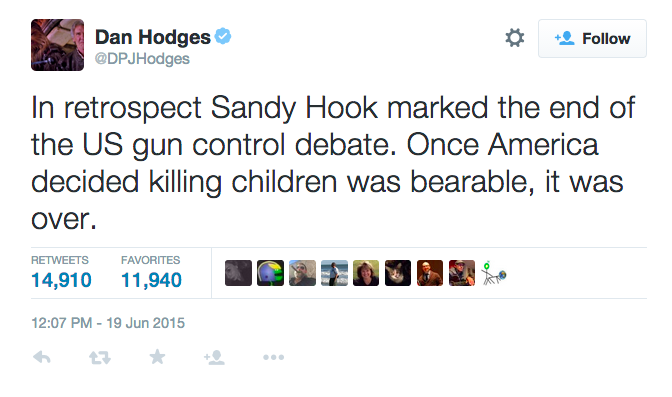
The Mass Shootings Tracker, a crowd-sourced tally of mass shootings maintained by the GunsAreCool subreddit, shows that we haven’t gone more than eight days without a mass shooting in the U.S. since the start of 2015 — that doesn’t leave a lot of time to grieve and regroup between shootings. We’ve averaged exactly one mass shooting per day since the start of the year. Forty eight days saw more than one mass shooting take place. On 18 days there were at least 3 shootings. On three days this year — April 18, June 13 and July 15 — there have been five shootings. (…) In the end, it often seems that the goal is to put off the conversation about the role of guns in America or quibble about methodology while the number of people killed or injured by guns rises. On the other hand, some people, like the Telegraph’s Dan Hodges, argue that we’ve already had the conversation, and that it’s already over. They may be right.

Here is what Dan Hodges tweeted that got the attention of the writer of the article above:

Screen Shot 2015-07-27 at 12.12.30 PM

Indeed. Have we decided that the massacre of 20 small school children is bearable. What have we become in order to satisfy a well funded corporate gun lobby’s appetite for power, influence and sales of weapons? Have we become the country reflected in the cartoon at the top of this post? The question has to be asked and answered. For what we do about this epidemic of gun violence reflects our values and who we are as a country.

We just have to decide what the price is for our insane gun culture as this writer is wondering: 

How much is one innocent life worth? Ten gun buyers waiting a few minutes longer to purchase a firearm? 25 buyers? 100?

I’m not going to tell you about how other countries have faced similar crises and collectively made the decision to enact reform. We aren’t other countries. As Americans we deal with issues at our own rate based on our own values.

Instead, I’ll point to an issue that the South just tackled: the Confederate flag. Since revisionist historians started to recast the role of the South in the Civil War in the late 1800s, it was pretty much an accepted fact that people were too divided over the flag for anything to ever change.

…and then it did. In a matter of weeks, the Confederate flag was relegated to the dustbin of history in South Carolina and companies that understood its harmful symbolism to so many Americans began pulling products from their shelves.

The change came at the cost of nine more innocent lives, but it happened. (…)

Our lack of action as a country suggests that we don’t value the lives of innocent Americans over the minutes of inconvenience that potential gun buyers might face. So unless we are willing to start telling our elected leaders to pass background check reform, we might as well continue to just haggle over the price of innocent lives.

Lives matter. Laws matter. Background checks or lack thereof matter. The proof is screaming at us. Are we listening?

We could listen to the voices of the victims. How about the video of one of the Lafayette shooting victims, Jillian Johnson, singing with her group in this lovely and moving tribute to her and her life. The victims have names. They have families. They had jobs, husbands, aspirations, opinions….. until suddenly they don’t.

We just have to be better than this.

Once a week….shootings

tiredmomAmerica is fatigued. One mass shooting a week- or at least that gets media attention. First Charleston. Then Chattanooga and now Lafayette, Louisiana. 3 are dead ( the gunman shot himself) and 9 injured in yet another theater shooting. The dust hasn’t settled yet on the trial of the other theater mass shooting in Aurora, Colorado yet and we are having flashbacks of the 12 killed and 70 injured in that shooting.

From the above linked article:

They described the shooter as a 58-year-old “lone white male” with a criminal history but did not immediately disclose his name. Lafayette Police Chief Jim Craft said the gunman was by himself and started the rampage by shooting the two people sitting in front of him.

At least one theatergoer described the attack, saying an older man stood up about 20 minutes into the 7:10 p.m. showing of the movie “Trainwreck” at the Grand 16 theater in Lafayette and began shooting.

Sound familiar? A lone white male. Someone with a criminal history who had a gun.

Sigh.

Yawn.

Congress?

Louisiana has the highest rate of gun deaths in the country:

An analysis of the data published Wednesday (June 18) by the Violence Policy Center found high rates gun deaths in Louisiana and other states correlates with weak gun protection laws and high gun ownership. The VPC, which bills itself as a national educational organization working to stop gun death and injury, also found states with stronger gun control laws and less gun ownership had lower rates of gun deaths. (…) In an unusual move for Louisiana, the state Legislature and Jindal have agreed to enact one new gun restriction. Domestic abusers under a legal protective order will be prevented from owning a gun for 10 years under a new law that will go into effect Aug. 1.

This happened in 2014.

Guns matter. Laws matter.

Gun free zones? Much is talked about recently because of the Chattanooga shooting at 2 military establishments that were “gun free” zones. And yet, according to new reports, one of the military members shot back at the shooter:

At a news conference here, the F.B.I. confirmed that at least one service member shot at the attacker, but did not say whether he had managed to wound the gunman, Mohammod Abdulazeez, who was killed minutes later in a shootout with the Chattanooga police.

“A service member from inside the facility observed him and opened fire on him, firing several rounds at him,” said Edward W. Reinhold, the special agent in charge of the F.B.I.’s Knoxville office. Two guns belonging to service members were recovered from the scene, he said, and “at least one of those weapons had been discharged.”

So much for the argument that the Chattanooga military facilities were gun free zones. But armed citizens have taken it upon themselves to “protect” these “gun free zones”. It hasn’t gone well so far. An Ohio “good guy” with a gun “accidentally shot off his AR-15 while “guarding” a military facility there. So much for more guns making us safer. From the article:

A police report said 28-year-old Christopher Reed was holding the rifle outside the recruiting station near the River Valley Mall in Lancaster, about 40 miles southeast of Columbus, at about noon when someone asked to look at the weapon. While Reed was clearing the ammunition from the rifle, he accidentally fired a shot into the pavement.

Reed was given a summons to appear in court on a misdemeanor charge of discharging a firearm within the city limits. A call to a number listed for him in the police report rang unanswered.

Sigh.

The military is treating these armed folks as potential danger. I wonder why?

So far the gun extremists are yelling that the Louisiana theater was a “gun free zone”. Not sure about that. If theaters have policies not allowing guns, they do so for a reason. Allowing people with guns inside a dark and crowded theater is just not a good idea. Small children and families go to movies. Why the need for a gun? Could someone really have stopped this shooter once he took everyone by surprise when he stood up and started firing? What does the average person do when hearing a gunshot and observing a shooter? Run to get away. That’s the natural and usual response. Firing back in a crowded dark theater with people running around? Ludicrous. But in addition, this Florida concealed carry permit holder shot an innocent young father over texting and popcorn at a movie theater. Tragic. The “good guy” with a gun didn’t do so well in this case, did he?

So yes, let’s allow those “good guys” with guns in our theaters. Clearly those folks will stop shooters and protect themselves and others.

Meanwhile, the shootings that don’t make national news?

Michigan boy shoots and kills brother.

10 year old Louisiana boy shot and killed himself with gun he accessed at home.

14 year old Kansas teen shoots and injures another teen.

A weird California case resulted in law enforcement finding 1200 guns stashed in a dead man’s home.

In Georgia a man killed his wife, her 2 children and himself.

Where do the guns come from? Why do kids and teens have such easy access to guns? Why do domestic disputes too often end in death by firearm? Why does anyone “need” 1200 guns?

There are many more where these came from. But I’m tired of this. Aren’t you? Shouldn’t we be addressing our nation’s serious epidemic of shootings by talking about strengthening our laws? Shouldn’t we be changing the conversation about the role of guns and gun violence in a country at war with itself? More than 80 Americans a day are dying from gunshot injuries including homicide, suicide and accidents. This is a uniquely American tragedy. It’s a gun culture brought to us by the corporate gun lobby and their bought and paid for politicians.

We’re tired of the daily news about shootings. We are fatigued and battle weary with the media coverage and breaking news. That doesn’t mean we are worn down however. What it means is that we need to wake up and do something. We need to demand change.

This shooting left 2 more families grieving for a loved one shot in a senseless act of violence not seen in any other democratized country not at war. It left the injured with life long memories and maybe life long disabilities. It left those in the theater traumatized by the idea that they could have been one of the victims. It has left us all with a feeling of dread.

We don’t need more guns in more places as a “solution” to our problem of too many shootings. We need to keep guns away from those who shouldn’t have them in the first place and consider the actual problem that too many guns in too many places is posing for the public health and safety of Americans. We are not helpless to solve the problem. Only our elected leaders are in that position. And they are in the position to change things as well. The rest of us need to be pro-active in changing the conversation and demanding change.

We are better than this.

Where is common sense?

UPDATE:

A father , Peter Read, who lost his daughter in the Virginia Tech shooting has written a great blog about “gun free zones”.  From the blog post:

Now it’s routine for gun lobby commentators and politicians to blame mass shootings on the existence of so-called “gun-free zones.” This is a red herring, pushed by the gun lobby to advance a “guns everywhere” agenda, which insults the dead and mocks the living by reducing tragedy to a mere trope.

It’s past time to lay this fallacy to rest.

In our case, Virginia Tech had routine police presence in and around campus, which the gunman even accounted for in his planning. It’s pointless to debate what hypothetically could have happened if a student or teacher carried a concealed firearm in Norris Hall that day, because nobody will ever know. But such a debate misses the main point: Mary, and everyone else, would have been far safer if the shooter had been unable to obtain a gun in the first place.

In Chattanooga, everyone at the recruiting center, the first attack scene, survived despite a hail of rapid long gun fire, because the combat veterans present followed their active shooter training and helped others to shelter and to evacuate the building. In their case, effective training and quick thinking, not the presence of a gun, made the difference. Only time will tell what exactly happened at the second scene, but official accounts so far indicate our service members’ brave actions and teamwork probably saved lives.

“So-called ‘gun-free zones’ are not the problem, and victim-blaming is not a solution.”

So-called “gun-free zones” do not make people more vulnerable to gun violence. The fact is, 86% of mass shootings – which the FBI defines as four or more murders – occur elsewhere, such as at home, in the streets, or in workplaces, according to research byEverytown for Gun Safety. Many of these shootings relate to domestic violence, and more than half the victims of mass shootings are women. Many of these mass shootings never grab national headlines. You may not know this, but a mass shooting that killed two adults and two teenagers, and left an eight-year-old boy fighting for his life, happened just this month in a private home in Holly Hill, South Carolina.

So-called “gun-free zones” are not the problem, and victim-blaming is not a solution. Dangerous people’s continued access to guns is the problem, largely due to the gun lobby’s extreme agenda which harms everyone, including law-abiding gun owners, military members, and law enforcement. So let’s work on the real problem, together.

The solution is to strengthen our common-sense gun violence prevention laws, like legislation pending in Congress right now to ensure background checks occur on all gun sales. It won’t prevent every tragedy – nothing will – but it would go a long way toward making Americans safer.

Breaking news- mass shootings and gun insanity as far as the eye can see.

Latest News - Gold 3D Words on Digital Background.

On Thursday of this week, the breaking news was all about mass shootings. One could not look at any news media without the interrupted programming reporting about the shooting of Marines at a Naval recruiting center in Chattanooga, Tennessee. And today, the news is that another victim has died of the injuries sustained in Thursday’s mass shooting. Also on that day, the jury of the Aurora theater shooting trial returned a guilty verdict. Common sense happened. In addition, there was news about the upcoming trial of the Charleston church mass shooter. America was consumed by mass shooting.

What we didn’t hear about that day was that 80 other Americans died from gunshot injuries and hundreds more sustained injuries. What the news media did’t talk about was a spree shooting in Maine that killed 2 and injured 5. How did this guy get his gun, by the way?

Will there be a day when we won’t be talking about another mass shooting? When will we do something about all of this? Congress took a break from their work while families were grieving and people were being shot. This statement from the Brady Campaign is perfect:

The two stories dominating news headlines across the country both center on the issue of gun violence – an epidemic that kills 89 people in America every day, and injures hundreds more. Congress’ response to a grieving nation: another three-day weekend.

“Today marks one month from the Charleston church shooting, while just yesterday four Marines were killed while serving their country on US soil and the Aurora movie theater shooter was convicted for murdering twelve people. Gun violence leads the news today in every congressional district in America, and this doesn’t count local shooting incidents that fail to make national news,” said Brady Campaign President Dan Gross. “The issue of gun violence is very much on the public’s mind and the last thing Congress should be doing is taking another break. Our elected leaders should make it a priority to take immediate action to keep guns out of the wrong hands and that starts by taking a vote on H.R. 1217.”

Isn’t it time for them to get to work on solving one of our country’s most pressing public health and safety problems? When 32,000 Americans die in one year from gun injuries, isn’t it time to break out common sense, put our collective heads together and start working on solutions? For there are solutions and we are ignoring them.

I write often about, at the least, requiring background checks for all gun sales. 92% of Americans, and yes, even gun owners, favor this solution. Why is this not the solution? Why would we even think about allowing anyone who purchases a deadly weapon to not go through a background check? It’s insane.

A group of faith leaders has written about another solution and is imploring President Obama to use it in this New York Times piece:

For more than a year, we and fellow religious leaders across the nation have worked to persuade President Obama to use what we believe is the most powerful tool government has in this area: its purchasing power. The federal government is the nation’s top gun buyer. It purchases more than a quarter of the guns and ammunition sold legally in the United States. State and local law enforcement agencies also purchase a large share. Major gun manufacturers depend on these taxpayer-funded purchases. For the government to keep buying guns from these companies — purchases meant to ensure public safety — without making demands for change is to squander its leverage.

Some of the leading brands of handguns purchased by the government — Glock, Smith & Wesson, Sig Sauer, Beretta, Colt, Sturm, Ruger & Company — are also leading brands used in crimes. Among the brands of handguns recovered by the Chicago Police Department at crime scenes between January 2012 and October 2013, all six of these companies ranked in the top 11. When police officers carrying Glocks are recovering Glocks at crime scenes on a regular basis, shouldn’t this prompt questions about whether the police department could use its influence to reduce the number of guns that end up in the hands of criminals? When Smith & Wessons turn up frequently in the hands of criminals, shouldn’t questions be asked when Smith & Wesson seeks a contract with the federal government?

There are specific suggestions made by these faith leaders that could lead to safer practices of selling guns to make sure guns don’t fall into the hands of those who shouldn’t have them. Why would we not require these gun dealers to more accountable for what they are doing? They are selling deadly weapons designed to kill people.

Along the line of common sense solutions suggested in the above linked piece is another article that highlights the gun sale policies of Walmart, the nation’s largest seller of guns:

Current federal guidelines offer dealers a degree of discretion in the small percentage of cases where background checks don’t clear within two hours and are placed under review, after which many retailers will opt to proceed with the sale even if an approval or denial hasn’t been issued when the three-day mark passes. Walmart’s own background check policies have surpassed federal requirements since 2002, when the company decided that it would no longer sell guns to customers without a completed approval from NICS. The company refuses to sell a gun without a concrete all-clear from the federal system.

“The fact is, a gun dealer is not required to sell a gun to anybody,” Jonathan Lowy, director of the Legal Action Project of the Brady Center to Prevent Gun Violence, tells The Trace. In default proceed sales, he argues, it’s safer not to. In a 2000 FBI study, the agency found that a person whose background check takes over 24 hours to complete is also 20 times more likely to be a prohibited purchaser. “Walmart realized that it’s just not good practice as a responsible corporate citizen to supply guns to those people,” says Lowy.

Walmart, the nation’s largest gun retailer, sells rifles, shotguns, and ammunition in some 1,700 outlets. (It doesn’t offer handguns, except in the state of Alaska.) In 2008, the company adopted even more rigorous standards by implementing a 10-point code of conduct as part of a partnership with the gun safety group Mayors Against Illegal Guns. In addition to refusing default proceed sales, Walmart agreed to videotape all firearm transactions, require background checks for all employees handling or selling guns, and create a system to trace guns sold by the company that are later linked to crimes, among other measures. (Mayors Against Illegal Guns is an earlier iteration of Everytown for Gun Safety, a seed donor of The Trace.)

Other gun dealers need to follow these simple good practices when selling guns. Lives depend on it.

Making sure kids and teens don’t access guns can also save lives. The ASK campaign is all about asking if there are loaded, unsecured guns in the homes where your kids play and hang out. Making sure if you are gun owners yourself, you do the same, is crucial.

The solution is not more guns, by the way. There is absolutely no evidence that works. In fact the opposite is likely true. For example, this Georgia navy recruiter accidentally shot himself in the leg with his personal weapon carried into a recruiting center. But now, of course, Republican Presidential candidates and gun rights activists are suggesting that if only those Chattanooga victims would have had guns, they could have protected themselves.

Pandering.

How would that have worked? The shooter shot from a distance spraying the buildings with bullets and it happened by surprise as these events always do. Perhaps military members working in these facilities should be armed but armed and trained. But even then, it may not stop the next armed attacker from spraying bullets from a distance. Like in any situation where a gunman shows up, chaos ensues and more guns do not ensure more safety and fewer deaths.

Even armed officers and law enforcement are shot and killed or injured in “guns allowed” zones. One of the first victims in Chattanooga was an armed police officer who was injured and couldn’t stop the shooter. I have written often about the shootings of armed officers in Tacoma, Washington, Pittsburgh, New York and other places.

Arming more people is not the answer. The answer is to have fewer armed citizens. There are far too many guns circulating in America. There are far too many people who shouldn’t be abel to have guns who can access them far too easily. The evidence is mounting that in America we make it easy for shooters like the Aurora shooter, the Columbine shooters, the Charleston shooter, the Chattanooga shooter, the Sandy Hook shooter and all of the others to gain access to deadly weapons.

A new study that draws the same conclusion as others, finds that guns for self defense are used very infrequently and that, indeed, do not actually make much difference and could make things worse for the gun owners. From the article in The Trace:

Despite these advantages, even the NCVS is almost certainly overestimating defensive gun use. The fact is that defensive gun use is an inherently rare phenomenon: Any survey, no matter how well designed, will produce a final estimate that is much higher than its true incidence because of false positives. Not only is this a well-established statistical phenomenon, it’s also supported by new data from the Gun Violence Archive (GVA) — the most comprehensive and systematic effort to catalog every publicly available defensive gun use report — which finds that there were fewer than 1,600 verified DGUs in 2014.

In response to GVA data, pro-gun advocates have been forced to argue that the reason researchers can barely find .064 percent of the 2.5 million DGUs a year claimed by Kleck and Gertz is because virtually nobody reports their defensive gun use to the police. This argument is problematic. For starters, it would seem to imply that the vast majority of people using guns in self-defense are irresponsible citizens who use their firearm to ward off an attempted crime, and then, perhaps uncertain about the legality of their action, are leery of interacting with the police. It would also imply that while these citizens ostensibly stopped a crime serious enough to justify brandishing a firearm, they aren’t at all concerned about informing the police about a criminal who remains on the street.

The only thing we can know for sure is what we have empirical data on: Namely, that there is a reliable floor for defensive gun use estimates at around 1,600 a year. In addition, according to the most recent data on defensive gun use, we have reliable evidence showing that owning a firearm does not give individuals any significant advantage in a criminal confrontation, and they are no less likely to lose property or be injured by using a gun in self defense.

Facts matter. We need to re-think our insane gun culture and the claims made by the corporate gun lobby. For saving lives is the most important thing we can do and if the facts point to stronger gun laws and discussing the role of guns and gun violence in our communities that don’t fit with the claims made otherwise, it’s time to change the conversation.

As if to punctuate the evidence about our daily news and breaking news reports about shootings, Everytown for Gun Safety has a new report about the trends in mass shootings and other shootings. It is not a pretty picture. You can read the facts for yourself but surely the report reveals that more guns and more easy access to guns had made our country far less safe. Let’s look at just one fact, though, considering the shootings of the past few weeks:

Here’s some further evidence to support this point. Last year, Media Matters noted that response rates to mass shootings are generally within minutes of the first shot fired. During the September 2013 Navy Yard shooting which claimed 13 lives, for example, local police arrived within two to three minutes and members of the Yard’s armed security force had already fired at the shooter but failed to stop him. In 2012, Mother Jones found absolutely no evidence that even a single mass shooter had considered whether someone in the area could legally be carrying a firearm. Instead, shooters choose locations based on their personal connection to the site — and don’t seem to care much about whether someone might be firing back at them. Perhaps that’s because many mass shooters are suicidal; Everytown says that in 42% of incidents, the shooter killed themselves.

Facts matter. We can’t let this trend continue.

Today is my birthday. I have much to be thankful for. So today I will celebrate with the usual cards, birthday cake, time with friends, calls from family and time at our beloved cabin on a lake.

Too many people will not be celebrating birthdays. Too many families will not be able to celebrate the birthdays of their loved ones, killed by gun violence. It’s all around us.

We are better than this.

UPDATE:

This article about an Oregon felon arrested with guns and ammunition is the poster child for everything that’s wrong with our American gun culture:

Broke told police that he had the gun “out of concern for his safety because of all the guns on the street,” court documents state.

You just can’t make this stuff up.

Of “Mad Men”, lapdogs, car dealers, gun giveaways and biker gang shoot-outs

Texas bikers
Thanks to Parents Against Gun Violence

There is always so much to write about that it’s difficult to find the starting point. But I think I’ll start with the biker gang shoot-out in Waco, Texas on Sunday because the irony is so delicious. Let’s first take a look at who showed up at this massacre that took the lives of 9, left at least 18  injured and led to the arrest of 172 or so.  You really can’t make this stuff up. From the article:

Open Carry advocates and bikers packed the State Capitol grounds in January in hopes of pushing for more lax gun laws. Among those bikers was Mike Lynch, who was also one of the culprits in the Waco bloodbath. (…)

Mike is one of the 172 bikers who were arrested after the carnage in Waco, leaving 9 dead and at least 18 injured.

In January, at least 2,000 bikers made their way to the State Capitol for a day of lobbying. Gun rights was at the top of their list of priorities, Fox 8 reported.

“They’re going to try to take our guns because some looney toon killed a bunch of people,” one biker said in January.

I can’t fit anymore irony in one sentence than that.

Lynch wrote on Facebook, “What a great day!” above a post referencing their attendance at the Texas Capitol.

So when we let the gun lobby and its’ minions write our gun laws, this is what we get- a lot of dead people in a massacre that most law enforcement said they have never seen in all of their years of working in the field. And it’s true that the gun lobby, whose interests are not that of even most gun owners, write the laws.

I love this statement about what happened in Waco from the Brady Campaign:

“Everything is big in Texas,” said Jonathan Hutson, spokesman for the Brady Campaign to Prevent Gun Violence. “Including big biker shootouts and even bigger loopholes that allow criminals and other dangerous people to buy guns without a Brady background check at gun shows and online”

Ah- the irony again. Now here was a group of mad men, for the perpetrators were mostly men. And mad they were- over some slight that allegedly happened in a restaurant bathroom and perhaps someone drove over someone’s foot in the parking lot? That’s enough to make you mad all right. But did people have to die over these petty arguments? The answer is, of course, NO. But when a gun, and in this case other weapons as well, are available, it’s easy to kill someone in an instant in an argument.

What I am saying is that guns are the most commonly used weapon in homicides. And this case was a prime example. Other weapons were used but the 9 who died apparently, from the information I have found,  all died of gunshot injuries:

….“When you get in an argument with a group of outlaw motorcyclists,” Thompson wrote, “your chances of emerging unmaimed depend on the number of heavy-handed allies you can muster in the time it takes to smash a beer bottle. In this league, sportsmanship is for old liberals and young fools.” The addition of guns proved predictably deadly. But whose bullets killed whom and why?

As if on cue, the right wing is blaming law enforcement for the deaths. At this point we don’t know who killed whom. But it seems clear from several articles that the biker gangs had made some statements threatening to shoot police officers.

And as if to make the public, who mostly support common sense when it comes to gun laws– yes- even in Texas- madder, the Texas legislature is thinking about expanding gun rights to allow just about anyone to open carry their pistols and other guns and with a provision that prevents law enforcement from asking them for their permit to carry. Seems like a good idea, right? This is the gun culture we have, thanks to spineless politicians who care more about their campaign treasure chests and saluting to the corporate gun lobby than about common sense and actually doing something about the public safety they were elected to protect. This is the definition of mad men– meant broadly to include all legislators.

They are lapdogs to the gun lobby. Shame on all of them. Check out this Brady Campaign video for the satire and the truth about our politicians:

Sigh.

Closer to home, a local car dealer decided it would be a good idea to give pistols away in a promotion to get customers to buy cars. Great idea, right? What message does this send to the public? Why do we think giving away a deadly weapon should be a part of a business promotion?  Some of my Facebook friends alerted me to the one page prominent ad in the local newspaper. This prompted quite a big discussion on Facebook and through e-mail about what we could do to express our concerns about such an ad. ad for gun give away

Yesterday more than a few phone calls were made by concerned citizens to both the local newspaper and the local car dealer. We learned that the Pawn Shop that had apparently donated the guns for the promotion, is a licensed firearms dealer and will perform background checks on any person who walks away from the gun dealer with a gun. The problem is that there was no disclaimer to that effect in the ad as there should have been. We also learned that the both the newspaper personnel and the car dealer representatives to whom we spoke were quite adamant that a background check should be required. If that is the case and the importance of a Brady background check was expressed, one wonders why there is so much resistance to requiring all gun sales to have one? Calling attention to the fact that many gun sales go without background checks will help to change the conversation about the role of guns and gun violence in our communities.

By coincidence, I took my car to my dealer for an oil change and some other maintenance yesterday where I spoke to one of the managers who I know. He said that this ad was the topic of their morning meeting. They were quite concerned about the lack of information about whether a background check would be required. Their other concern was for the bad message this sends to the public leaving them embarrassed for car dealers who have to sink to giving guns away to get business.

What is happening here is that the veritable “chickens are coming home to roost.” When we sit back and allow the insane and well funded single interest gun lobby groups to make our laws without thought to the consequences, we encourage such a cavalier attitude towards guns that when something happens like the Waco shooting, people are taken aback and proclaim surprise. When a car dealer gives gun away in a prominently placed ad in a local paper, some people just think it’s part of our culture and no big deal. Others, however, take notice and they don’t like it. The problem for this gun dealer here was that the ad was so large and the image of the two pistols so obvious that it called attention to itself. That is what they wanted but I don’t think the result is what they expected.

This is NOT the gun culture the general public wants. But it is the gun culture we have. It is also not the culture we have to accept. Things are changing.

Dan Gross, President of the Brady Campaign wrote this great piece yesterday about how changes to social mores occur over time and how we have learned to do a better job of protecting our children and our communities from hard, sometimes the hard way.  From the article:

And then it struck me, what could be more inspiring than Mad Men? Not only as a great way to end a speech, but as a powerful demonstration of how much the world can change and how quickly that change can happen.

In less than a generation how many of the things we see on that show have gone from perfectly acceptable — even glamorous or sexy — to socially unconscionable? How many dangerous, reckless or harmful things that we used to do without second thought, are things we would not even consider doing now? (…)

The fact is, if we can just keep guns only out of the hands of people that every sane American believes should not have them in the first place, and inspire safe, responsible behavior around the dangers and risks of guns in the home, we can create extraordinary change.

But first, we have to stop talking about guns as a partisan political debate and start talking about gun deaths as the public health and safety issue that they are.

Don Draper famously said, “If you don’t like what’s being talked about, change the conversation.” That is precisely what we must do to address the problem of gun deaths and injuries in our nation. Just like all the other issues that have changed so dramatically in the generation since Mad Men, we have to start talking about solutions based on our common goals and values, like health, safety and freedom from fear.

Dan Gross is right. Gun violence is a public health and safety epidemic. Making that worse by passing looser gun laws rather than stronger laws has deadly results. Promoting gun giveaways for advertising promotions is just not a good idea given the increase in gun deaths and the obvious public health problem resulting from our cavalier and insane gun culture. We don’t have to accept the way things are. We can step up to make change and it can happen in small ways as well as large. The “Mad Men” culture isn’t the culture we have today, though some would say that the advertising culture prevalently featured in the popular series still exists in some ways. But luckily we know better about some things and people no longer openly smoke and drink in the work place or let kids play with plastic bags over their heads.

If local car dealers realize that they shouldn’t give guns away as a way to get people to buy cars, then change will happen. If Texas legislators are scrutinized for their own role in listening to the wrong people while making gun laws, then change will happen.

It is so obvious that something is terribly broken with our American gun culture. But why do we let it continue without making the changes we deserve? Ask your legislators to be responsible decision makers when it comes to public safety. Ask them to stop being lapdogs to an industry that sells deadly weapons without concern for public safety. Ask other parents if there are unsecured guns in homes where your children play. Ask businesses to think twice about allowing loaded guns in places where families gather. Ask questions when you aren’t sure a policy is going to actually keep children and families safe from devastating gun violence. Make phone calls, send e-mails, realize that laws matter and there are consequences to bad laws.

We can’t shrug our shoulders and just walk away thinking that nothing will change anyway so why bother. We can make a difference if we put our heads together for common sense.

Let’s get to work. It’s past time to challenge things that have become socially acceptable but are actually harmful and dangerous. Let’s do it before more harm is done. Lives are at stake and we are better than this.

The affects of Minnesota’s worst school shooting, Red Lake, 10 years later

broken heart

(This has been cross posted at commongunsense.com.)

Broken hearts. Broken dreams. Broken spirits. A broken community. It’s been 10 years since the worst school shooting in Minnesota- the Red Lake shooting. Ten years ago the teen shooter went to the home of his grandfather, stole his service weapons, killed his grandfather and his girlfriend and proceeded to his school. There he shot and killed 7 more and himself at the school. 5 were left injured.

This morning I heard a story on Minnesota Public Radio about the continued after effects of the March 21, 2005 Red Lake school shooting. The title of the article is what caught my attention- “Feeling scars at Red Lake, 10 years later”. From the interview ( which you can listen to as well as read):

The day has rippled across the Red Lake Indian Reservation since then. Today, about 6,000 tribe members live on the reservation, and just about every resident in those miles of stark landscape lost a friend or a family member, a loss that continues to sting.

At the time, it was the deadliest school shooting since Columbine, and it remains the largest mass homicide in Minnesota history. Including Weise, 10 people died. More, like May, were wounded, and many more saw things they can’t forget. (…)

Ten years ago, May was tall and strong and just getting to the age when people take you seriously in the Red Lake Nation. He played football and basketball, and he lifted weights in his free time.

By 18, he figured he’d have a real shot at a football scholarship, and a ticket off the reservation.

And he was in love. He planned to marry Alicia White, a girl in his class.

On the third Monday of March, his life shifted. Jeff Weise came into his classroom and shot five students and a teacher. May saw Alicia die. He saw his friend Dewayne Michael Lewis drop and then he charged Weise with a pencil, and was himself shot in the face. The bullet cut downward, ripping through nerves and lodging by his spine.

The last thing he remembers, he was on the floor with blood in his mouth.

Later in the story, one of the FBI agents, first on the awful scene said this as he reflected back on the day ten years ago:

“I learned that kids are capable of anything,” he said, “that they’re capable of planning.”

The fact that kids can get their hands on guns and cause this much tragedy and affect the lives of so many is an American tragedy.

Others are interviewed for this first part of a poignant series on the devastation left after a shooting that  took the lives of 10, including the shooter. It’s hard to read how the physical and emotional scars still remain- how the lives of so many were affected and how victims and survivors live with the trauma. Even law enforcement officers are traumatized and suffer life long problems after a mass shooting such as the one at Red Lake. Scenes like this are horrific and sometimes I wonder if the gun rights extremists recognize this. At some level they must. But their answer is so often that another gun would have solved the problem- particularly a “good guy with a gun”.

I am always puzzled and dismayed by this response to national mass shooting tragedies. Is there empathy for the victims? Do some on the side of gun rights believe this could never happen to them so why get upset and try to prevent more similar shootings? Since the Red Lake shooting in 2005 there have been dozens more deadly school shootings and many other gun incidents in our schools. Yet, we have been unable as a country to come together to have a civil national conversation about how we can prevent more of them. Surely passing some common sense gun laws such as requiring background checks on all gun sales would prevent some of the crime guns from getting into the hands of those who shouldn’t have them. We do know that the majority of the public supports this idea and understands that a measure like this won’t interfere with their own rights to own a gun for self defense and hunting. And the benefit is that it could prevent at least some shootings. But the corporate gun lobby has instilled fear into our public leaders who then become complicit in lack of action.

But it’s more than lack of strong background checks. It’s a gun culture where those who have them often don’t take safety measures to prevent those who shouldn’t have them from getting them anyway. This gun culture is one of often cavalier attitudes towards guns as if they are not actually deadly weapons that can kill other human beings. Some say they are just “tools”. Tools for what? It turns out that they are tools for killing innocent people. Guns are deadly weapons designed to kill other human beings and pose a risk to those who own them.

The Red Lake shooter knew his grandfather had service weapons that were apparently unlocked so provided easy access. Way too often the gun used in a mass shooting or other shooting comes from the home of the shooter or a close relative. The other notorious 2003 school shooting in Minnesota at Rocori High School was also a case of the young shooter accessing the gun of his law enforcement father.

Both of these shooters were diagnosed at some point with mental illness by health care professionals. Mental illness, teens and guns have been a theme in American school and other shootings. What should we, as a country do to help prevent people like this from gaining access to guns? One simple measure is storing guns safely- locked securely, unloaded.

Obviously improving our mental health services to teens and adults would go a long ways towards stopping some tragedies before they happen. But the easy access of guns just has to be in the conversation. The fact that it is often shoved to the bottom of the list is the measure of how insidious is our gun culture.

Mass shootings haunt the victims, survivors and the communities in which they occur. Shootings cost Americans greatly, not only financially, but some suffer life long disabilities as a result, or PTSD and other emotional problems. In this story, addiction to drugs and alcohol and mental illness also have plagued some of the victims. Life goes on- but for some it is not at all the life they hoped for or were planning.

It is important to listen to and read about these poignant stories of survival. Gun violence is insidious and affects more than just the primary victims and their survivors. There is a huge cost to our gun violence epidemic. How many more will pay before we demand action and changes that can make a difference? We are better than this.